A Reflection on My Summer Research Experience

In these past 10 weeks, I’ve spent 250+ hours in the lab at the University of Scranton researching, running protocols and taking care of lab maintenance. I was able to broaden my technical skills through collaborations with two faculty members in the Chemistry department, Dr. Michael Fennie and Dr. Kate Stumpo. The field of Neuroscience is often heralded as a multidisciplinary area of study, taking expertise in fields of biology, psychology, chemistry, physics and others to understand the mechanisms of cognitive function such as we do in the Biopsychology Lab under Dr. Orr.  I found the times spent discussing research with other faculty or student members to be the most rewarding part of my internship. At times my internship was difficult, especially the moments when certain protocols were unsuccessful or obstacles arose due to temperamental machinery. We had difficulty getting a protein concentration curve, setting me off on a week of problem solving with the protocol, but ending up with no resolution. Additionally, more time was spent tweaking the machinery needed for analysis than I had anticipated.  I’m grateful for the opportunity I had this summer to intern with the Biopsychology lab where I could learn the basic schedule of day to day research. I was able to gain technical skills with protocols for Western Blotting, organic chemistry synthesis, and protein extraction and permethylation in addition to learning about the funding and ordering resources available for a research lab. My pursuit of answers to the questions I ask regarding normal or abnormal brain function, can be answered through my work as a researcher in Neuroscience. However, it can take longer to yield results and require the inclusion of other scientists for a holistic understanding of neural function, and this internship has only confirmed for me that I can be successful as a researcher to add toward our current theories.

Cassie Stapf
Neuroscience and Philosophy

The Challenges and Rewards of Bat Population Research

One major challenge that I’ve found in the course of this internship is that research can be somewhat discouraging. The decimation in the bat population demographics in the Northeastern United States since the White-Nose outbreak in 2006 has been well documented; however, it is different to know this information theoretically than to physically go out in search of bats and come up empty. I think bats are fascinating animals, as well as an essential part of forest ecosystems, so it can be frustrating to do population research and see the depth of the problem firsthand without having any means to help fix the issue. That being said, the experience I’ve gained over the course of the past several weeks has been rewarding overall. Even though there is no instant gratification or breakthrough associated with this type of population study, it is comforting to know that the data that we collect can help other researchers understand the bat population dilemma in great detail and hopefully take a step closer in finding the solution. We are hoping that our data will be published locally as part of an ongoing study of Northeastern bats post-2006 and that the combined data collected by researchers across the United States may help stop the spread of White-Nose Syndrome.

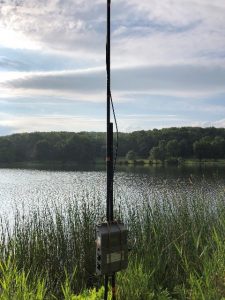
The SM3 recording device and microphone positioned in a bog next to Lackawanna Lake before sundown. The device is very heavy so we have to use several bungee cords to stabilize it on the poles. The microphone (not pictured) is delicate and must be out of reach of both animals and humans.
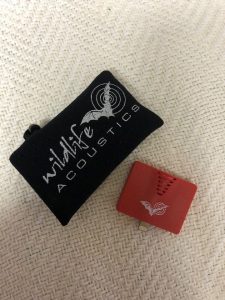
The Echo Meter Touch 2 hardware. This hardware plugs into an iPhone port and communicates with a corresponding app (see Figure 3 and 4).
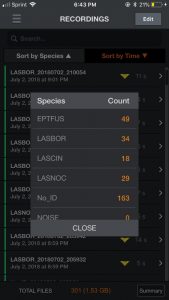
A screenshot from my iPhone. The Echo Meter device (see Figure 2) communicates with the Echo Meter App which records and analyzes bat calls in real time. The column reading “Species” lists off the four species of bat that we have definitively found in Lackawanna State Park and corresponds the species label with their “Count.” The “Count” column does not tell us number of members of that species that we recorded, but merely the number of calls recorded. This makes it difficult to get an accurate population estimate.
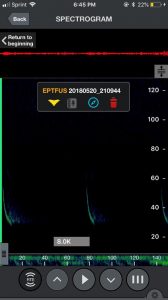
A screenshot of the Echo Meter app from my iPhone. This diagram shows three echolocation calls made by Eptesicus Fuscus, more commonly known as the Big Brown Bat. Though based on the spacing it appears that all three calls were made by the same bat, we have no way of definitively proving whether one bat made all three calls, or three bats each made one call, or one bat made two calls and another bat made the other call, etc.

Tate Ackerman
Biology, Spanish, Philosophy

While Memories Fade, Friendships Last a Life-Time

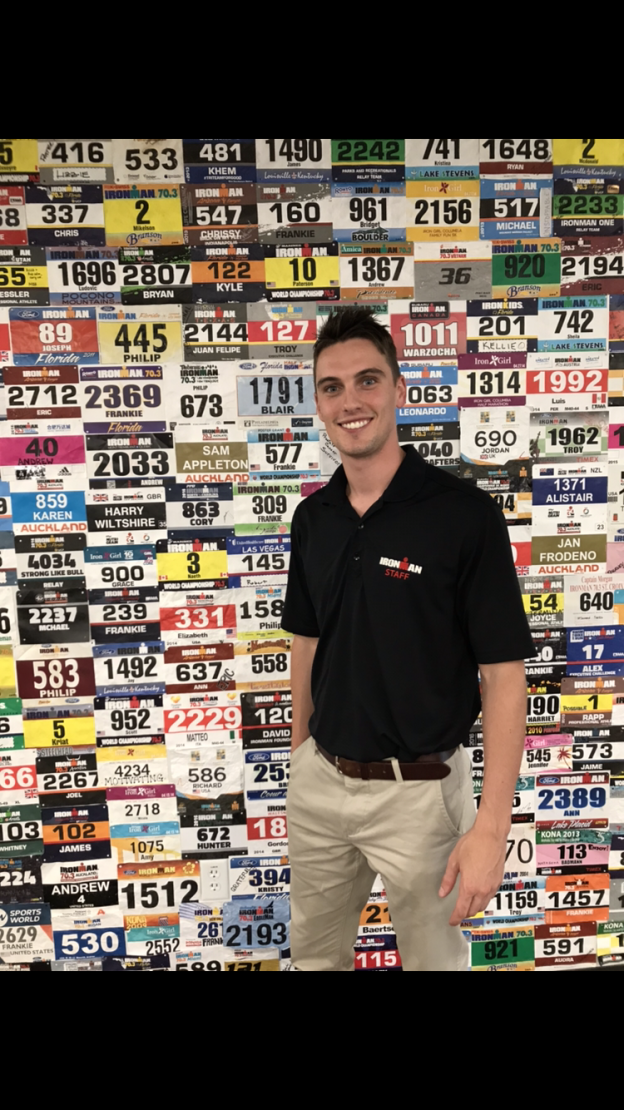
Interestingly, the most challenging part of my internship would later prove the most rewarding. Nearly 1,000 miles away from my family and friends at home, Tampa forced me to momentarily start anew. As a “lone Royal” in unfamiliar territory, I made it my mission to show the Bay Area Thomas McGinley in all of his true colors – hopefully, not blushing too much along the way. As I had no roommates to rely on for easy conversation or extracurricular activities, I was left to bring my dynamism to the workplace. What started off as “coffee talk” within my own department soon morphed into intimate personal connections with interns and co-workers alike, throughout the company. Before long, my unofficial label of “indispensable summer help” switched to “peer” – someone worth listening to in regard to original thought. While my time at IRONMAN was short, I feel as though the various relationships forged between its walls will serve me well in my future of sports marketing. Today, it is safe to say that my entrusted colleagues were successful in imbuing me with the spirit that “anything is possible” before my time with them drew to a close. Hopefully, my newly adopted mantra will serve me well in my next challenge, wherever and whenever it may be.

Thomas McGinley
Marketing

My Own Exposure and Response Prevention

My Royal Psychology Experience at McLean Hospital has been remarkably rewarding and surprisingly challenging. This summer, I drafted my book chapter on mindfulness in schools, observed clinical interventions, and been trained to administer two clinical assessments. While I enjoy honing my research skills, the most rewarding part of my experience has been forging relationships with staff. Each staff member has shared his or her experience with and advice on graduate programs and career opportunities. The treatment team’s transparency and approachability has made them a valuable future resource.

Though rewarding, my tenure at McLean has been challenging. We only have four patients and are currently training new staff members. Staff observe interventions before delivering them independently, and because some patients are uncomfortable with multiple observers, I have fewer observation opportunities currently. My inability to participate in treatments has proven more challenging than restricted observation access, however. As a research assistant, I am forbidden from delivering clinical interventions to patients, but I often find myself wanting to participate in treatment administration. In the future, I will seek opportunities that provide hands-on experience with similar techniques.

Overall, my work on the unit has enriched my understanding of OCD and the disorder’s impact on clients. Following my Royal Psychology Experience, I am more confident in my decision to pursue a career in mental health and more aware of the various opportunities available in my field.

Bobby McGowan
Philosophy & Psychology

A CPAF Thank You

The most rewarding parts of my internship were the experience I gained and the connections I made during my time there. Some of the work experience I now have because of my internship includes assisting with account reviews and preparing account reviews for clients, updating client portfolio values, developing Excel spreadsheets, and generating reports. The people I met during my time there were not only friendly and knowledgeable, but I know I can turn to them for help with interviews and job placement. The most challenging part of my internship was becoming familiar with all the different softwares that are used at Northwestern Mutual. Although I only learned the basics of softwares like Morningstar, NetX360, NMCIR, CRM, and Envestnet, I sometimes found it difficult to remember how and where to find information that was needed. Moving forward and for the future, I want to become more proficient in these softwares since they are commonly used in the financial industry. Overall, I am grateful for the opportunity I had this summer and had a great learning experience at CPAF!

Amanda Spiteri
Finance

Persistence in Research Begets Success

While recounting the last two months, I’ve realized that my time was spent primarily outlining procedures, conducting experiments, and dealing with alternating waves of successful and failed studies. The first eight weeks of my summer internship consisted of tweaking experimental procedures to study vicinal protein thiol oxidations. By two weeks ago, my experiments no longer focused on protein thiol oxidations because we encountered enough obstacles trying to study them that we decided that our sanity could be salvaged by pursuing a question pertaining to protein thiol alkylations instead. Perhaps the most challenging aspect of my internship was maintaining interest in the question I was trying to answer when experiencing failure.

Each optimization experiment I performed offered hope that we could pursue experiments on pathways of protein thiol oxidations in vivo. Yet, each experiment that implemented stronger protocols revealed a new challenge and a different problem in the methods. Each new and seemingly unpredictable failure with the methodology battered my desire to pursue the hypothesis I outlined at the beginning of this summer. Having been involved in intense research since my freshman year, I expect failures and I love troubleshooting in my research projects. But spending seven hours on an experiment before encountering a flaw in methodology elicits great frustration. Even for those who enjoy their research. Nevertheless, my love of problem-solving and systematic testing enabled me to complete my experiments. Although I failed to prepare methods to study my first research question, persistence in research facilitated experimental success in beginning to elucidate the mechanisms of protein thiol alkylation by 3-Bromopyruvate.

A few days after we changed the focus of my project, we successfully completed an experiment and obtained reasonable data. The optimization experiments that I viewed as failures several weeks ago allowed us to obtain data successfully. Thus, effectively obtaining usable results with the methods I designed—over a period of several months—in collaboration with Dr. Foley and my other lab partners was the most rewarding aspect of my summer research project.

Although the research project that I originally foresaw as straightforward presented frequent, sometimes insurmountable challenges, my determination in optimizing experiments and my love of problem-solving in research led me to find some success after weeks of failure

Stefan Olsen
Biochemistry

Surrounded by Industry Leaders

The most rewarding part of my internship at Wasserman this summer was working alongside sports marketing professionals that have been in the industry for several years. Before Wasserman, many held roles with professional sports leagues or worked in the sponsorship divisions at Fortune 500 brands. It was incredible to be surrounded by people that have the same passion and that were once in my shoes as rising seniors. I scheduled time with many of my managers throughout the summer to learn more about their career paths to their current positions in the company.

In a few short weeks, I’ll be returning to campus for my final year as an undergraduate at The University of Scranton. I anticipate that it will be a very busy time with school work and the full-time job search. I hope to stay in touch with many of my former coworkers at Wasserman and use their advice from our meetings to position myself well in the application process.

The most challenging part of my internship was working on projects with sports I was not familiar with. Over time, I developed a greater understanding of the business behind those sports.

I am very thankful for the opportunity to work at Wasserman this past summer. I can’t wait to use what I learned about sports business in my career one day.

Mark Miller
Marketing and Business Administration

Family Law

Melissa P. Rudas, Esquire came into my life when I needed it the most. After three collegiate years littered with major changes and career uncertainty, I found myself utterly lost. I took an internship position with her office without any real experience in the field of law with the hopes of finding some direction. However, what I found was so much more. Not only did I learn what it takes to be a successful attorney, but I became a part of a family and built inseparable bonds that I will forever cherish. Melissa recognized my potential and challenged me every day by holding me to her extremely high standards. She not only pushed me to be the best intern I could be but pushed me to be the best person I could be. In doing so, my passion for law grew and I began to experience the type of career equanimity I craved for so long. For me, the most rewarding aspect of my internship was being able to not only work with such a masterful professional, but to work with such a truly special and caring person. To say that Attorney Rudas is one of the most amazing individuals I have ever met is, quite honestly, an understatement. Through both the good and the bad, Melissa’s consistency and passion radiated from every aspect of her being. Melissa is a beacon of strength for those who need it most. She has changed so many lives for better, including my own. Melissa, thank you for everything you have done for me! Words cannot even express how grateful I am for your presence.

Andrew Milisits
Philosophy

The First Four Weeks as a Museum Registrar

So far, my experience at the Everhart Museum of Natural History and Art has been one that I will appreciate in my many years to come. As an Art Major, I understand that sometimes in order to achieve a goal of becoming someone who teaches art at college level, or in his or her own studio, he or she must first work to gain as much knowledge about the art world as is possible. Working in a museum has so far expanded my knowledge about local art, and what goes on behind the scenes; that is, what happens behind those white gallery walls in order to create an exhibition that would catch the interest of the public, no matter their age. What I have been doing holds the title of Registrar- I am entering their art collection into a database called Past Perfect. Up until now, the Museum’s collection has been recorded on notecards and other obscure forms in over 30 drawers of file folders. The collection numbers over 6000, and in the 4 weeks I have been there, I have made it through nearly 400 files. One might think that number is not very impressive, but it is so much more than retyping cards into a database. Some items have very little to draw upon, so I do research, and find out as much as I can about the particular item. Or, in some cases, there are email correspondences, hand written letters, and type-written thank yous for pieces donated. This experience, so far, has given much more insight as to what happens in a museum when its doors are closed to the public, and I am very excited to discover what waits for me in the coming file folders

Jordan Oakey
Liberal Studies with concentrations in Studio Art, Art History, and Education Theory

Perfectionism and Passion

I will spend my Royal Psychology Experience as a summer research assistant (RA) at McLean Hospital’s OCDI Jr. in Middleborough, Massachusetts. A Harvard Medical School Affiliate, McLean Hospital established OCDI Jr. in 2015 as a residential and partial hospitalization program for children and adolescents with severe obsessive-compulsive disorder (OCD). As an RA, I will spend my summer coauthoring a book chapter on mindfulness in schools, designing a study on the relationship between perfectionism and OCD severity, observing clinical interventions, and attending presentations on other research projects underway at McLean.

I hope that my tenure at OCDI Jr. will help to clarify my post-graduation plans. Though I plan on pursuing a Ph.D. in clinical psychology, I lack research experience and am therefore unsure whether my passion for research compares to my passion for clinical work. Clinical psychology Ph.D. programs require graduates to complete independent research projects, and I would therefore like to learn whether I enjoy research before committing to such a program. If research proves less exciting than clinical work for me, then I will likely apply to practice-oriented Psy.D. programs next semester.

Whether my tenure at OCDI Jr. strengthens my resolve to pursue a Ph.D. in clinical psychology or points me in a new direction, I am truly excited to begin my Royal Psychology Experience. I am confident that each of my on and off site experiences this summer will further contribute to both my personal and professional development.

Bobby McGowan
Philosophy & Psychology