A Blog of Writing Resources from The University of Scranton's Writing Center

Category: Resources for Freshmen (Page 2 of 2)

How to Write About Literature

There’s certain conventions that you need to know when analyzing a short story or comparing literary works by the same author. For example, you need to know how to write the title: is it in quotes? Is it italicized? Are you using a long quote or  a short quote when inserting the text? Do you know how to cite it? Are you writing an analysis opposed to a plot summary? Do you know what tense to use when describing actions that occurred in the work?  There’s a lot of rules!

Here’s the Golden Rules When Writing About Literature:

  • Don’t summarize, but analyze. Your instructor has read the text and doesn’t need a detailed recap. They are more interested in how you can interpret the text. What do you think is significant about the text?
  • Read the text closely.  Annotate as you read in order to  identify a unique a theme or a idea. We have a digital worksheet to walk you through that process here.
  • Have a strong thesis. Check out our resources for thesis statements here.
  • Know the literary terminology and use it effectively.  Here’s a quick list of terms, definitions, and samples.
  • Use the present tense when describing actions in the piece.
  • Use the present tense when describing what the author does.
  • Remember that the narrator is different from the author.
  • Write the author’s name correctly. When you reference the author, write their first and last name the very first time you reference them. Use only the last name when referring to the author later in your paper.
  • Use direct quotes from the text. Generally, it’s better to use the quotes than to paraphrase  so your reader can see the exact text.
  • You must provide an explanation of each quote you provide. What is the significance of the quote? How does it support your thesis? Why did you include it? What does it do/say/indicate?
  • Make sure you cite your quotes correctly by using in-text citations. Check out this quick guide. If you have multiple works by the same author, you’ll need to include some extra information.
  • Indicate titles correctly. Titles of larger works or containers (like books, plays, anthologies) are italicized. Shorter works within containers (like chapters, poems, short stories) have “quotes” around them.
  • Use strong verbs. Let’s avoid “is”, “are”, “has”, “does”, and maybe even move away from “says” and “states”. Check out the list of strong verbs for literary essays here.
  • Use good sources. If you have to use other sources, use the databases in the library, not google.  Check out these databases first.
  • Use your professor’s office hours. Once you have a rough draft, go to your professor’s office hours and see if you’re on the right track. Don’t skip this step. Professors may look for different qualities in papers, and you need to know what they expect from you. For example, I once had an English professor that wanted my paper to contain most of the lecture notes. I later had a English professor that did not what me to use any of the ideas discussed in class. Instead, he wanted my own original ideas about the text. Those are very different expectations!
  • Beware of the internet. I know students will browse the internet as a way to get their own ideas flowing. No Fear Shakespeare, GoodReads, and SparkNotes offer chapter-by-chapter interpretations of classical works. That doesn’t mean they are high quality, but they usually have a brief, easy-to-read format, which draws students to them in their brainstorming process. Don’t do it! But, if you can’t resist this temptation, then keep track of each source you read and remember to cite it correctly if you use that idea or a very similar idea anywhere in your paper.

Here’s a detailed handout with examples of  how to use these rules.

It’s one of my personal favorites. It  provides excellent examples of summary and analysis paragraphs.  It also gives you examples of strong thesis statements for literary papers, and it demonstrates a variety of in-text citations with MLA format. I strongly recommend you check it out before you write your next English paper.


Other Tools and Resources:

Student Sample Essays Student Sample Essay Paragraph-by-Paragraph 

Student Sample Paper in MLA format

Student Sample Essays  on Poetry Analysis Student Sample Paper
Upper Level Student Sample Essays A Compilation of Student Sample Papers  from the 200-400 Level Literature Courses
Graphic Organizer for Literary Analysis Multiple Graphic Organizers

Using a Research Log

A research log is a tool to help you organize, analyze, and evaluate sources  as you begin to gather information about a topic. It typically consists of a  table with labels across the top that serve as a set of instructions when approaching a new source.  Filling out each column helps you gather the information you need for your project.  For example, you’ll need to include the full-citation in your research log, which will allow to to copy and paste the full citation into your completed draft later. You also need to include what makes the source credible, so you’ll remember to check if it’s peer-reviewed or scholarly. That information will become important later as you determine which of your sources should be included in your draft based off their relevance and credibility. Perhaps you’ll have some sources in the log that support your argument, but they come from low quality sources. Comparing the credibility will help you make those choices.  Most importantly, a research log lets you  place all of your evidence in one spot so can easily compare data from each source. The table will ensure that you don’t confuse your sources or accidentally plagiarize by crediting a fact to a different  source. Finally, there’s a space for you to analyze the evidence in the log and link it to your main argument.

There’s two major reasons for using a research log :

1.) It will keep you organized.   Rather than jotting notes in a notebook, filling in the required information for each column in a research log will ensure you’ve collected the needed information before moving on to the next source. You won’t have to keep returning to previous sources or struggle to remember how you found a source because your search terms and databases are in the log. You’ll also never lose a source or forget where a quote came from.

2) It will help you compare  your evidence. Having the evidence from all of  the sources in one place lets you look at the data side-by-side to evaluate which items would be best to include in your paper. Looking at all of the evidence in a research log can also help you refine your thesis before you begin drafting.

If you have to write a paper that requires research, this tool can save you a significant amount of time, and it could eliminate stress later on in your writing process.

Here’s a template for a Research Log


Transition Words and Phrases

It’s time to abandon the simple “First” , “Second”,  “Finally,” and  “In conclusion” transition words from high school. It’s no longer acceptable to have “and” twice in a single sentence or “also” twice in the same paragraph. You instead need words, phrases, and constructions that not only transition your thoughts, but that reflect the relationships between your ideas.  Listed below is my favorite list of transitions sorted by the relationships they express.

The Best Quick List of Transitions and Conjunctions Sorted by Type

This next list is another one of my favorites. It’s less colorful, but significantly more extensive. It also includes more academic transitions,  and it has longer transitional phrases. It’s three full pages of transitions by type.  Just be sure to look up sample constructions–not all of these words can just be inserted into a sentence. For example “embark” is used very differently in a sentence than “commencing with”

The Best Extensive List with Some Uncommon Transitions Sorted by Purpose

This next resource is a chart of common transitions in the “word” form and in the “phrase” form with examples of how to use them effectively in sentence constructions. All of these words are included in the previous two worksheets, but  this particular resource  is useful if you need to convert a one-word transition into a phrase to emphasize a point. Sometimes writers use full phrases to transition between larger ideas (or paragraphs) and single word transitions to move between little ideas (like individual pieces of evidence).  It doesn’t provide a lot of examples, but it shows how to use each in a sentence correctly with punctuation, which is beneficial.

Samples of Word Transitions Converted to Phrase Transitions with Examples 


Using Quotes

by Owen Stanczak

To select quotes, it is important to first understand what it is that you are talking about. Trying to select quotes without a strong central thesis often leads to a jumble of unrelated segments from the text or texts you are using for support.

The first step is to think carefully and clearly about the point you are trying to make. What is your claim? Why did you choose that claim? Was there something about the text that led you to your conclusion? What specifically about the text relates to the claim you are making?

Once you have established your claim, begin thinking about which parts of the text that you are using relate to specific parts of your claim. Thinking about this will allow you to pinpoint areas where you may find the most relevant quotes. I always try to remember specific sentences or phrases that stood out to me while reading.

Once you find quotes that fit your claim, begin to organize them. You can do this by writing them down, or using sticky notes. Use a system to organize them, whether by topic, or by order which they will appear in your paper. Using different colored sticky notes to differentiate topics, and numbering each sticky note in the order in which the quote will appear in your paper is one effective method.

Once you have chosen and organized your quotes, you can easily incorporate them into your paper. Just make sure to introduce and explain your quotes when they appear in the paper and you’re all set!


 Introducing and Analyzing Quotes

How to Build  Complex Paragraphs with Quotes

Integrating Quotes Correctly to Avoid Plagiarism 


The Process of Crafting a Thesis


Writing a thesis is a process. You start with a topic, it evolves into an idea, and then you refine it as you analyze your evidence until it’s an interesting claim. You don’t have a real thesis statement until you have crafted it to be as focused and as intriguing as possible.


Students with weak or underdeveloped thesis statements often stopped working on them halfway through the writing process, or they did not allow themselves enough time to hone their argument. Here’s what the thesis writing process generally looks like.

Here’s an example of a prompt:

The original fairy tales by Jacob and Wilhelm Grimm are frequently portrayed in pop culture today. We see these adaptations in our favorite TV shows, video games, and movies. The audience knows the major elements of the fairy tale, yet they still enjoy embarking on the familiar journey. Why is that? Why are they enjoyable when the ending is well-known?  Pick a fairy tale and explain why it is still relevant.


1.) Exploring the Topic

What do I want to write about? I always liked the fairy tale called “Hansel and Gretel”.

Why do I want to write about it? I love the idea of a candy house. I love candy. Who doesn’t? First, I’m going to actively read the original story here.

What does the candy house mean? Well, the candy house is actually a trap made by a witch who wants to eat the children. Both the children and the witch are hungry. Maybe that’s significant? Maybe all of the characters are hungry?  Is there a better word for hungry?


2.) Not a Thesis:

Thesis: Hansel and Gretel eat the candy house because they are starving during a famine.

This is not a thesis because it is not debatable. It’s a specific fact from the story. How can we make it debate? Well, let’s focus on a theme rather than one detail.


3.) An Off-Topic Thesis:

Thesis: Television series Once Upon a Time adapts “Hansel and Gretel” to depict how children could get lost in grief after experiencing the death of a loved one.

This is a claim, but it’s off topic. Return to the prompt. This instructor is not looking for an example of a fairy tale adaptation in pop culture. Rather, they are seeking a close reading of the text and an argument as to why the story is still meaningful. Return to the original prompt throughout your writing process so you stay focused on the right topic.


4.) The Weak Thesis

What am I showing my reader?  The fairy tale “Hansel and Gretel” is about hunger.

How will I show it? There’s examples of overeating throughout the story.

Thesis: The fairy tale “Hansel and Gretel” is about hunger because there’s examples of overeating throughout the story.

We have an idea, and we have the evidence that lead to the idea, but this thesis is weak because the “examples of overeating . . .” is a vague statement. Who is over eating? What about hunger? Is there a more specific word that relates to hunger and over-eating?  The verb “is” can also be strengthened by using an action verb.


5.) The Slightly Stronger High-School-Thesis-Statement

What am I showing my reader?  All of the major characters in “Hansel and Gretel” struggle with gluttony.

How will I show it? I’ll show it through three groups of characters. The parents abandon their children because they are starving and don’t want to share the remaining food. The children overindulge when eating the candy house so they are sleepy. The witch wants to eat the children but not before she fattens them up.

Thesis: The well-known fairy tale, “Hansel and Gretel” is about gluttony because the parents, the children, and the witch are gluttonous.

Yes, gluttony is the right word, and that makes it a little stronger, but the 3-reasons-thesis will not serve you well in college. The general high school thesis format looks like this:

__________________ is true because  of_____________, ___________, and ____________.

It’s not wrong; in fact, it’s a good step in the right direction, but this format is a barrier to more complex ideas, and remember, your paper is only as good as your idea. This format limits you to three major reasons, and it doesn’t leave room for the actual relevance of the idea.  One way to make this stronger would be to look at the evidence we present. Can we put it into one major group or use one term to describe it all? The parents, the witch, and the children are all characters. Maybe that’s the term. When we use a term to group our evidence together, we make room for a more complex idea.


6.) A Stronger College-Level Thesis

Thesis: The well-known fairy tale, “Hansel and Gretel” portrays gluttony by featuring characters who all fail to manage their intense hunger.  

This thesis is more specific so it is by far stronger. Now we have room to make an interesting and complex thesis statement, and we do this by asking ourselves this: why is this theme still relevant? Why should our reader care about some fairy tale about gluttony? Often at this stage you may need to return to the story to draw out more evidence or think about other common themes. Remember, our prompt wants to know why this story is relevant. Why is gluttony relevant?

7.) The Strongest Thesis

What am I showing my reader?  All of the major characters in “Hansel and Gretel” struggle with gluttony so the reader can grapple with gluttony alongside of each character.

How will I show it? I will show that every character is gluttonous, and I will look at how little description exists for each character.

Why does it matter? Well, when I think of society today, I think of excess. We over-consume  not only food, but resources, and televisions shows through “binging” etc. Is this a form of gluttony?

Thesis: The well-known fairy tale, “Hansel and Gretel” allows the reader to vicariously grapple with gluttony by showing how each character in the tale fails to manage their hunger, making the story ever-relevant in a society that is defined by over-consumption.


This is the strongest thesis because it indicates what will be argued, how it will be argued, and why it’s significant
. It is specific, it is interesting, and it is debatable. It uses strong verbs and focused words.

A strong thesis like this is also thought provoking. It puts a new spin on something familiar to your reader so you have plenty of options for a conclusion, too. For example, once you prove that Hansel and Gretel is about gluttony, you can ask all sort of questions. Does liking “Hansel and Gretel” mean you struggle with gluttony? Is “Hansel and Gretel” constantly adapted because our culture hasn’t overcome gluttony? Is it still about gluttony in adaptations or are those essential details amended? If so, why?  What does the ending mean since the children return home to the parents that abandoned them for food? Is it all a cycle where they will be abandoning by their parents again during the next famine?  There’s so much here to explore and there’s a variety of directions for your conclusion.


When forming a thesis ask yourself these questions: 

  • What is my idea? 
  • How will I show it? 
  • Why does it matter?
  • Is my idea responding to the prompt? 
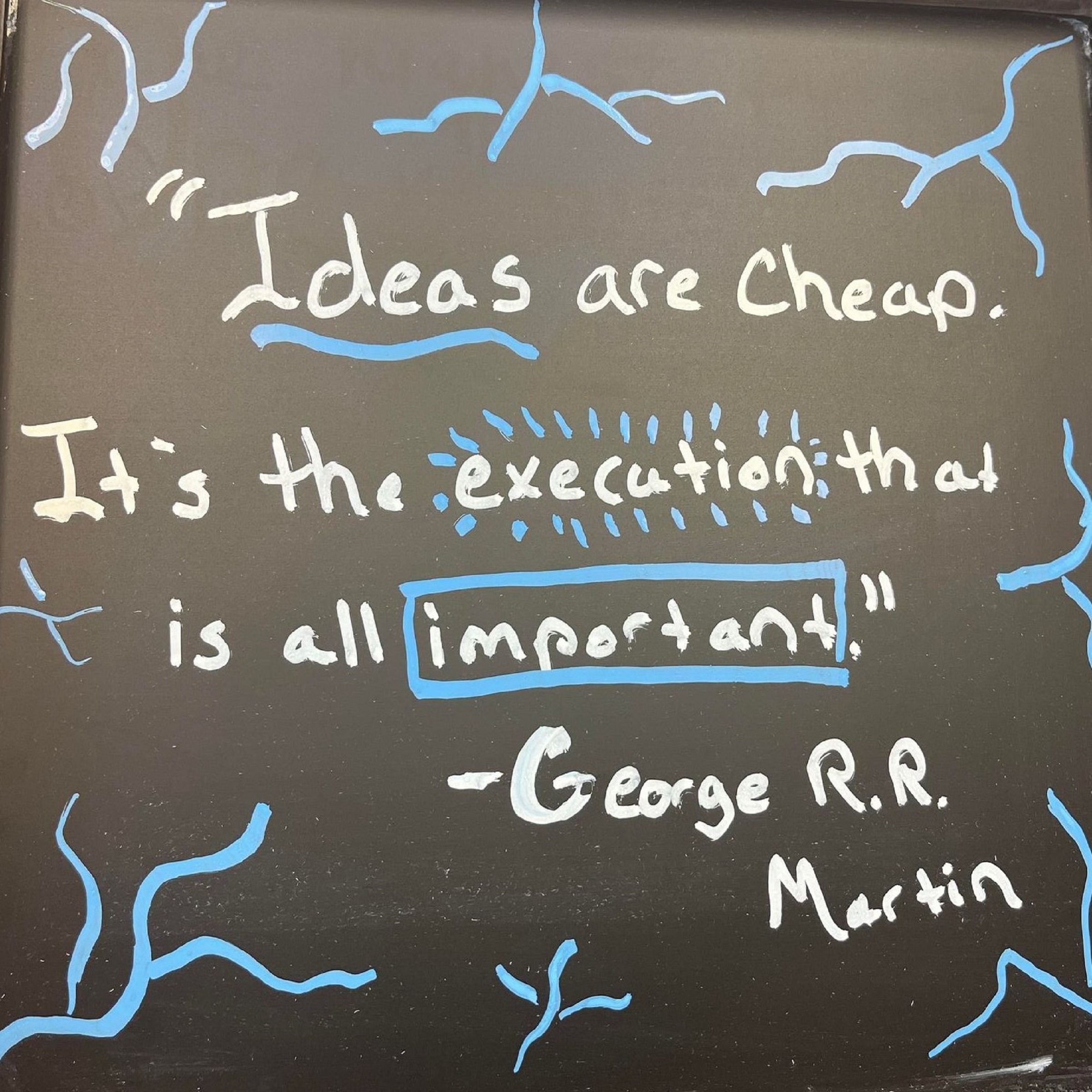
The Ending is Just as Important as the Beginning

by Stephanie Vasquez

Picture this. You have a big research paper that you’ve been working on. You researched, you outlined, you planned, and you wrote the most amazing paper ever…..and then you got to your conclusion. You’re staring at your screen, and you’re blanking. You don’t know what to write, and you don’t even know if your brain can even write anymore. Sound familiar? If you’ve ever been in this position, do not fear: you are not alone.

You’ve probably heard quotes like “starting is the hardest part of the journey” or “A journey of a thousand miles begins with a simple step”. While those are true, sometimes people forget to mention that ending the journey is also hard, and this applies to ending a writing journey as well. It is hard to start a paper, but once you get going and you have your paper written, the biggest struggle comes in ending it. So how do we do that?

This tip I’m going to give you is corny but bear with me. Imagine that you’re on stage during a rap battle. Your paper is the bars that you’re “freestyling’. Now, if you get to end your “freestyle” and you feel that you can’t drop the mic, then that means that your conclusion isn’t strong enough. Nothing kills a paper instantly than when you have a super super super strong paper….and then it flatlines at the end. Your conclusion is the very last thing people read. An introduction is memorable, but people are going to remember what you left them with even more.

Now this leads to another question, which is, how do you make your paper memorable? There is nothing I hate more than the words “in conclusion”, “as previously stated”, “as I mentioned before”, etc. We get it. We literally just read your paper! The audience should be able to tell that they reached the conclusion without you having to tell them. You don’t want to leave them wanting more, but you shouldn’t also have them wondering when you are ever get to the end. Tie up your ideas in your paper in a nice, short, and simple way. You don’t want to restate your ideas–you want to reinforce them. You want to synthesize them. You want to explain what the bigger implication is–why should your reader care that you proved your idea? Why does that idea matter? What’s the greater significance?

So now it’s my turn to end this, and how do I end this post? By metaphorically dropping the mic.

Here’s a guide to help you write strong conclusions. 


Newer posts »

© 2025 Scranton Writes

Theme by Anders NorenUp ↑