
Winners of the 2026 Bonnie W. Oldham Library Research Prize Announced

Bonnie W. Oldham Library Research Prize logo

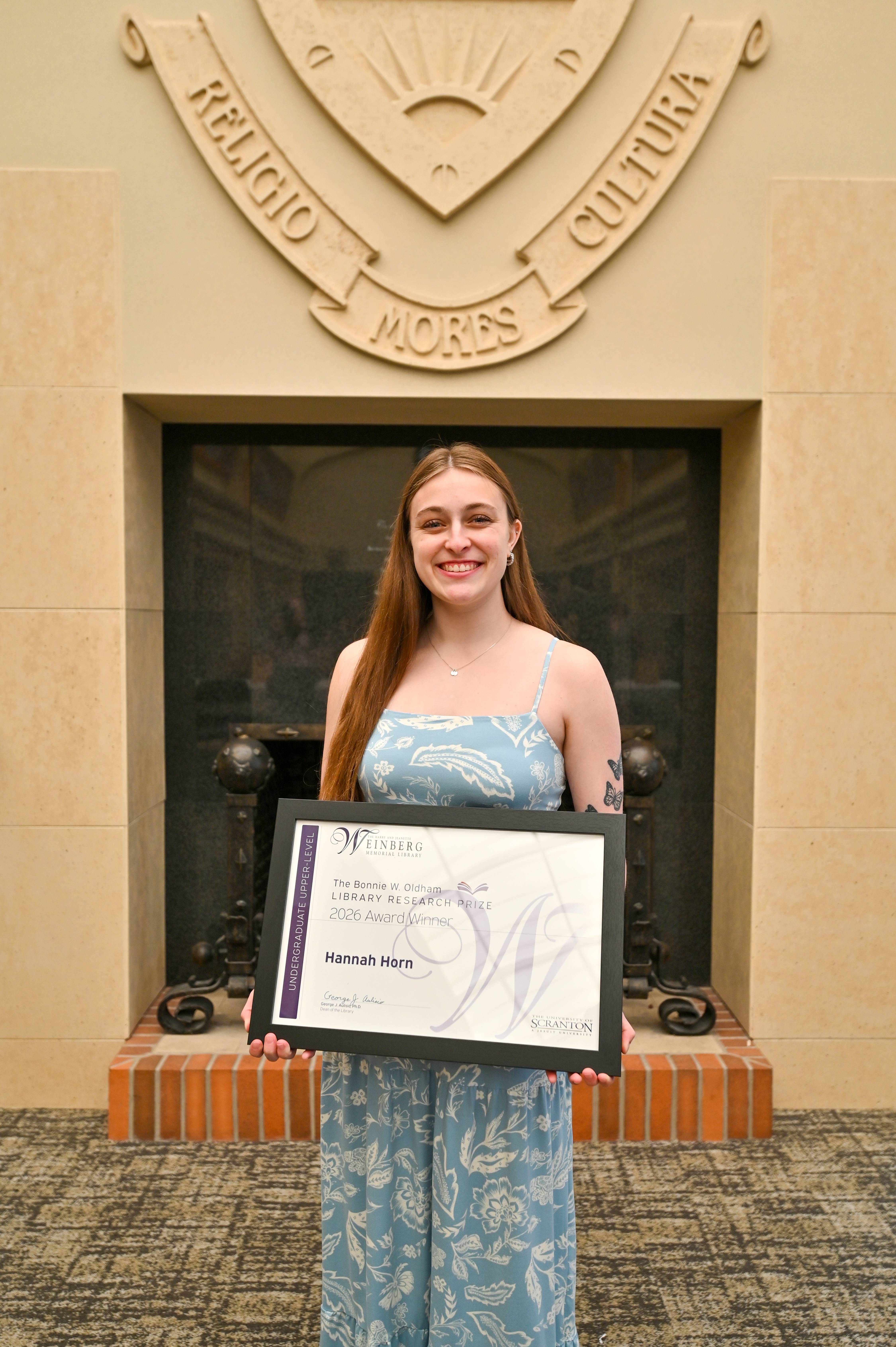
Research Prize Winner Hannah Horn holding framed certificate.
2026 Bonnie W. Oldham Library Research Prize Undergraduate Upper-level award recipient Hannah Horn.

Hannah Horn is the winner of the 2026 Bonnie W. Oldham Library Research Prize in the Undergraduate Upper-level category, awarded to the winning project completed in a 200- to 400-level course.

Hannah is a junior Cybercrime and Homeland Security major with a double minor in Criminal Justice and Criminology. She submitted to the competition her project titled, “Money Laundering through Online Gambling,” completed in the course CJ 231: Environmental Criminology, taught by Dr. Ismail Onat. In choosing a research topic, Hannah explains in her description of research, “My curiosity about money laundering through gambling began from a desire to understand how digital platforms, such as online casinos, introduce new risks to these conventional systems. At the beginning of the project, I recognized that the subject was extensive and impactful but had very little research regarding it.” 

For her research, Hannah drew on a range of tools and resources available through the Weinberg Memorial Library, including Royal Search, research guides, and the A-Z Databases list. In her description of the research process, Hannah discusses using the ProQuest Criminal Justice database to locate academic literature on both traditional and emerging money laundering methods, and she supplemented this with JSTOR and EBSCO’s Academic Search Premier to gather literature on regulatory frameworks and organized crime. Because Hannah’s topic sits at the intersection of criminology, cybersecurity, international law, and financial regulation, she describes using the Library’s unified search system to map citations and trace scholarly conversations across disciplines. She also consulted reports from the Financial Action Task Force and the Financial Crimes Enforcement Network (FinCEN), which grounded her research in real-world investigative practice. 

Throughout this process, Hannah strengthened her ability to evaluate source quality. She explains, “The library’s resources helped me to distinguish assertions from research grounded in evidence and helped to ensure that all the sources I used were credible and scholarly. I also learned to focus my research on peer-reviewed journals, official documents, and legal examinations, considering the reliability of their publication, research methods, sample size, and the availability of data.” She continues, “These thorough assessments embody the trait of discernment by distinguishing trustworthy information from deceptive or biased origins. This process required patience, contemplation, and a need for open-mindedness when presented with facts and information.”

Exploring this subject led her to consider the social and human dimensions of financial crime. Hannah writes:

Online casino sites […] commonly act as conduits for criminal organizations to exploit vulnerable groups, disrupt economies, and weaken confidence in the financial systems used. Researching this subject prompted me to embrace the concept of cura personalis, meaning acknowledging the human aspect behind what might seem like a purely financial framework. I gained an understanding of how illegal activities impact innocent people and communities, especially in nations with fragile regulatory environments and economies.

Hannah’s paper offers a robust analysis of online casinos as environments that enable money laundering, tracing the legal history of anti-money laundering legislation, applying criminological frameworks, and culminating in an original intervention proposal: an Integrated Account-Centric Anti-Money Laundering System. Her work is both analytically rigorous and practically grounded, demonstrating the kind of critical thinking that defines excellent upper-level research.

The Honorable Mention awards in the Undergraduate Upper-level category were presented to Corinne R. Langowski, a senior Communication Sciences and Disorders major, for her project titled, “Predicting Developmental Outcomes in Toddlers with Early Language Delay Using the Preschool Language Scale – Fifth Edition,” completed in the course CSD 412: Introduction to Research Methods, taught by Dr. Joseph Motzko; and Faith E. Montagnino, a senior English major with Philosophy and Writing minors, for her University Honors project titled, “The Wound as Method: Pain, Language, and Feminist Knowledge in Confessional and Post-Confessional Poetry,” completed in WRTG 489H: Honors Project II, mentored by Dr. Billie Tadros.

Aaron T. Redis is the winner of the 2026 Bonnie W. Oldham Library Research Prize in the Graduate category.
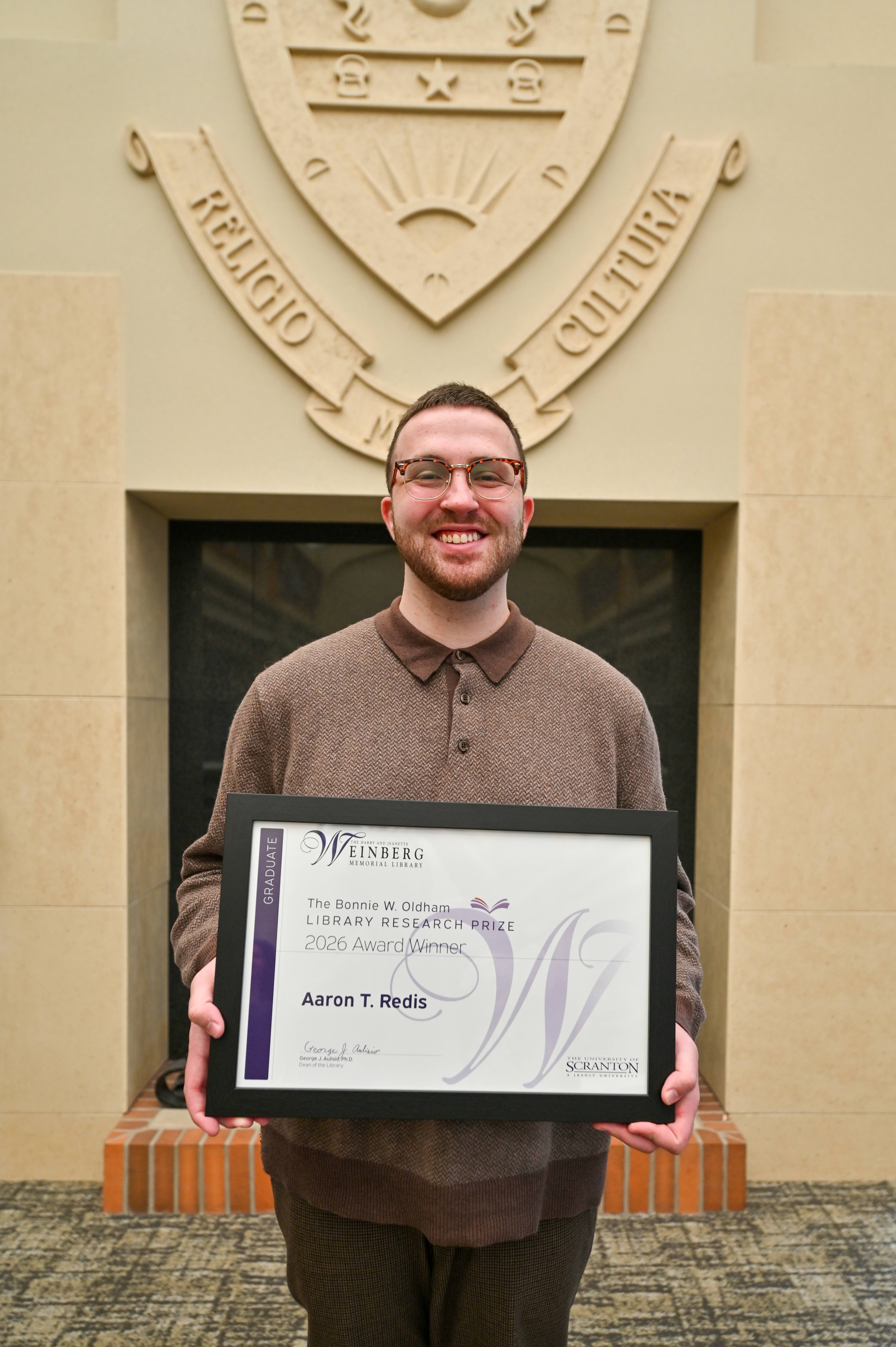
Research Prize Winner Aaron T. Redis holding framed certificate.
2026 Bonnie W. Oldham Library Research Prize Graduate award recipient Aaron T. Redis.

Aaron is in the Master of Science in Clinical Rehabilitation Counseling program. He submitted to the competition his project titled, “Seeing Trauma Differently: Evaluating the Efficacy of EMDR Across Varying Abilities and Contexts,” in the course COUN 521: Physical and Psychosocial Aspects of Disability, taught by Dr. Samantha Herrick. Aaron first notes in his description of research that getting started on a research project is often the hardest step. Deciding to research the broader topic of trauma, he utilized the Library’s resources including Publication Finder and Royal Search and came upon Eye Movement Desensitization / Reprocessing (EMDR) Therapy as his research topic for this project. About the scope of his research, Aaron notes, “I initially wanted to center the research on providing this therapeutic modality for individuals with physical disabilities. However, I quickly learned there was a significant gap in the scholarly literature, as I could only locate sources on EMDR for individuals with intellectual disabilities.”

This discovery led Aaron to focus his research on EMDR accessibility overall, relying on key sources to further refine the scope of his project, including in one case a playlist on virtual EMDR which he found through the Library’s search systems and which helped “inform [his] research on adapting EMDR strategies for broader accessibility.” In his description of research, Aaron describes the need to “draw meaningful conclusions” from the information available on a given topic, especially when there may not be direct evidence available on a particular aspect of the topic being researched. This is especially important in evidence-based fields such as clinical counseling practice. His use of a log for his sources, in which he recorded notes on pieces of evidence he found valuable or interesting, was a tool that helped him do this.

Aaron speaks about this process as “research by serendipity,” a phrase he uses in his description of research to describe how the synthesis of existing research may reveal gaps, but one can still build upon those works in a meaningful way to contribute further to the scholarly conversation. He goes on to reflect on his experience in graduate studies of “expecting [a project] to turn out one way, but the further we go along, we see it turn into something better than we may have expected.” He continues, “This taught me the value of being flexible and seeing that sometimes we grow in the process, even if it feels overwhelming or uncertain.”

In his description of research, Aaron reflects on the Jesuit values he identified in his research process for this project. He notes how through the process he learned that “Education is so much more than knowledge” and that “it is also about developing character and leadership,” which is how Aaron put magis into practice in this project. In addition, Aaron’s research discovery that EMDR interventions need to be adapted to individual client needs looks at a person holistically, which is the embodiment of cura personalis. On this, he reflects on what he’s learned about EMDR when he shares, “There is something to be said for a client trusting us with the heaviest parts of their lived experience; we must honor this by encouraging them to care for themselves in and out of the session, and sometimes slowing down or stopping EMDR is the best way to do so.” 

Lastly, Aaron speaks about how “deep reflection strongly influenced [his] research process” as he strove for continual improvement in the execution of this research project. He connects this to contemplation in action and notes that “Being able to sift through the research and come back to and draw meaningful conclusions matters a lot and determines how much someone takes away from the process.” Through this, Aaron illustrates how the research process impacts both the researcher and those whom the research will serve.
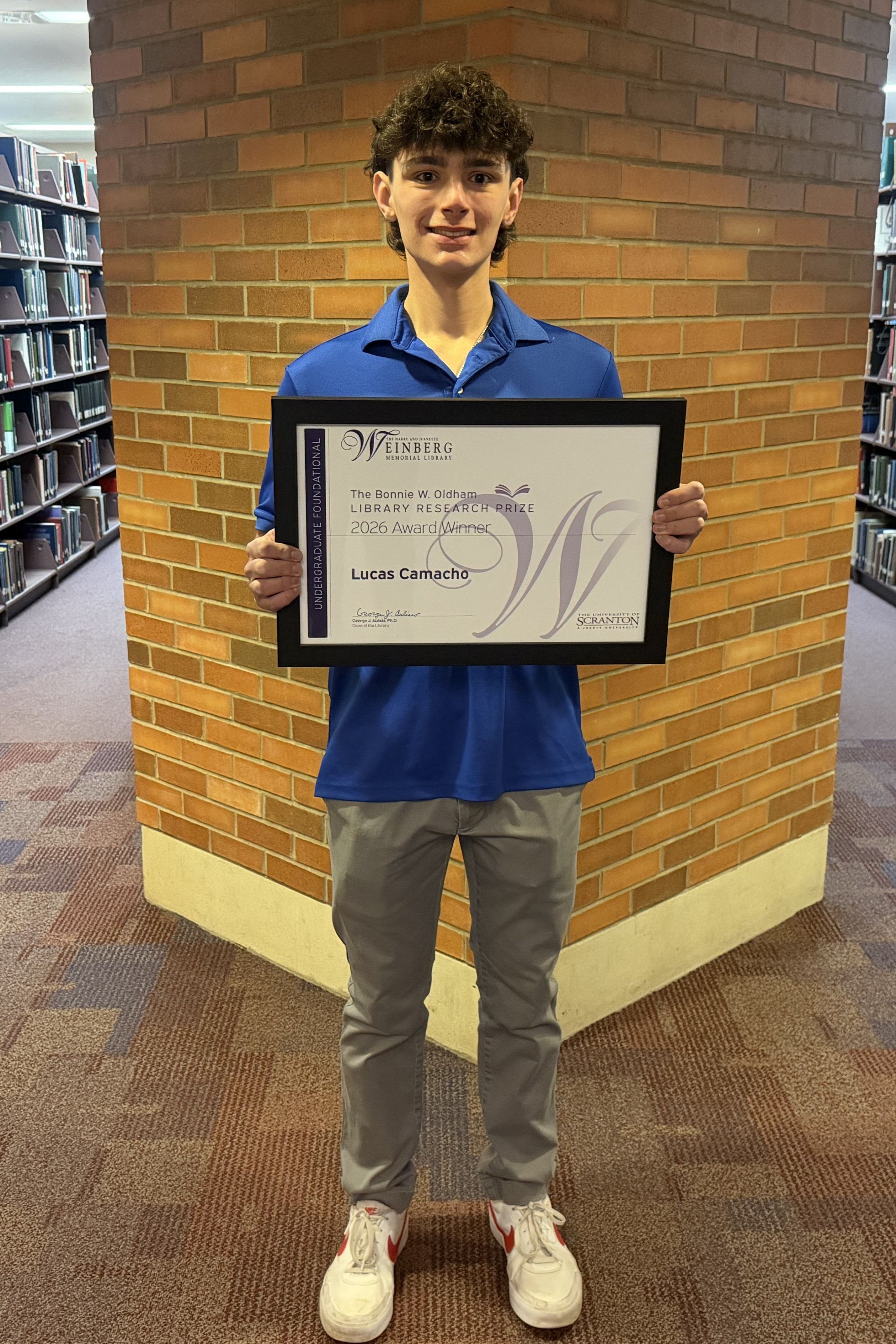
Research Prize Winner Lucas Camacho holding framed certificate.
2026 Bonnie W. Oldham Library Research Prize Undergraduate Foundational award recipient Lucas Camacho.

Lucas Camacho is the winner of the 2026 Bonnie W. Oldham Library Research Prize in the Undergraduate Foundational category, awarded to the winning project completed in a 100-level course.

Lucas is a first-year Kinesiology major on a Pre-Med/Pre-PA track who submitted to the competition his paper titled, “Building Habits that Last a Lifetime,” completed in Prof. Dawn D’Aries Zera’s WRTG 107: Composition course. Tasked with researching an argumentative contemporary issue related to his major, Lucas’s goal was to write about wearable fitness trackers. Getting started posed a challenge for Lucas, who shares in his description of research, “I was not sure how to transform that idea into a well-researched and supported argument. I kept telling myself I had to find the ‘perfect’ source to get started. This mindset kept me stuck […] Everything changed when I attended a class session instructed by Donna Witek, Librarian, at the Weinberg Memorial Library. This session gave me the direction needed to put me on the right track for success in this assignment.” 

In the information literacy class session, Lucas learned how to effectively use the Library search tools to locate specific materials needed to support his argument. He notes that he had never used many of the tools introduced in this information literacy class, but that the information presented in that class made him “confident about the process and how the information was organized.” Lucas began his research with Royal Search, the Library’s main search tool, which searches all of the Library’s databases, electronic resources, and print and media collections for books, articles, and more. Lucas shares that he immediately started applying the skills he learned in the information literacy class and mentions using features such as the filters provided by the platform to locate scientific, peer-reviewed literature relevant to his research topic, which he accessed through Library-indexed resources including PubMed, JAMA Network Open, The BMJ, Frontiers in Physiology, and The Lancet Digital Health. Lucas experienced success in combining multiple keywords using Boolean operators such as AND and OR to narrow or broaden his searches as needed. He notes, “Gathering evidence started to become a bit easier with each search, and I was able to start building my claim. Seeing the variety of studies that are connected to my topic helped me understand the scope of scholarship involved in academic research.”

Lucas details his use of reading the abstracts of discovered studies to ensure that they would be supportive of the claims he was making in his essay, and that this allowed him to conduct research more efficiently. He goes on to reflect on the research process as a whole saying, “The guidance from Professor Donna Witek helped me grow as a student. I developed a clear understanding of how to do academic research with intention instead of just guessing my way through it. This topic taught me how to find sources, but more importantly, how to think more patiently and critically.” Lucas also described a common challenge when conducting research and the ways he persisted through it using what he learned; he writes: “When I felt like my research process hit a wall, I remembered that Donna told us that research should be treated as a continuous process instead of just a one-time search. Sometimes the search did not bring up high-quality results, and it became frustrating. I was able to stay calm and focused when I remembered this research mindset. This was not just about collecting sources; it was about building the foundation and context of a truly compelling subject for me.”  

Lucas further reflected on the role the Ignatian characteristic contemplation in action played in his research when he writes:

Research provided me a chance to reflect on my thinking and fortify my skills, which will serve me further after this assignment. My argument highlighted the importance of building long-term habits. Ironically enough, the research process ended up teaching me the same lesson: progress comes from being consistent in habits. I became more confident in my academic ability based on the skills acquired to search intentionally, evaluate studies, and think critically. The same approach of consistent work, adjustment, and reflection applied to assignments and challenges beyond this one. 

The Honorable Mention awards in the Undergraduate Foundational category were presented to Nursing major Emma McMahon, for her project titled, “Prioritizing Cognitive Behavioral Therapy Over Pharmacotherapy,” and to Communication Sciences and Disorders major Abigail Wall, for her project titled, “Does Telehealth Improve Access to Healthcare or Compromise the Quality of it?,” both completed in WRTG 107: Composition for Prof. Dawn D’Aries Zera.

Currently celebrating its 16th year, the Weinberg Memorial Library inaugurated the Library Research Prize in 2011 to recognize excellence in research projects that show evidence of significant knowledge of the methods of research and the information gathering process, and use of library resources, tools, and services. In 2017, the prize was named for Professor Emerita Bonnie W. Oldham, who founded the prize at the University in 2011. The Bonnie W. Oldham Library Research Prize was fully endowed in 2019 and consists of a prize of $500 awarded to winning projects in each of the three categories: Undergraduate Foundational (100-level projects), Undergraduate Upper-level (200- to 400-level projects), and Graduate.

Prize winners were honored at an Awards Ceremony & Reception on Friday, May 22, 2026 in the Charles Kratz Scranton Heritage Room of the Weinberg Memorial Library.

Information about the Bonnie W. Oldham Library Research Prize can be found on the website: http://www.scranton.edu/libraryresearchprize
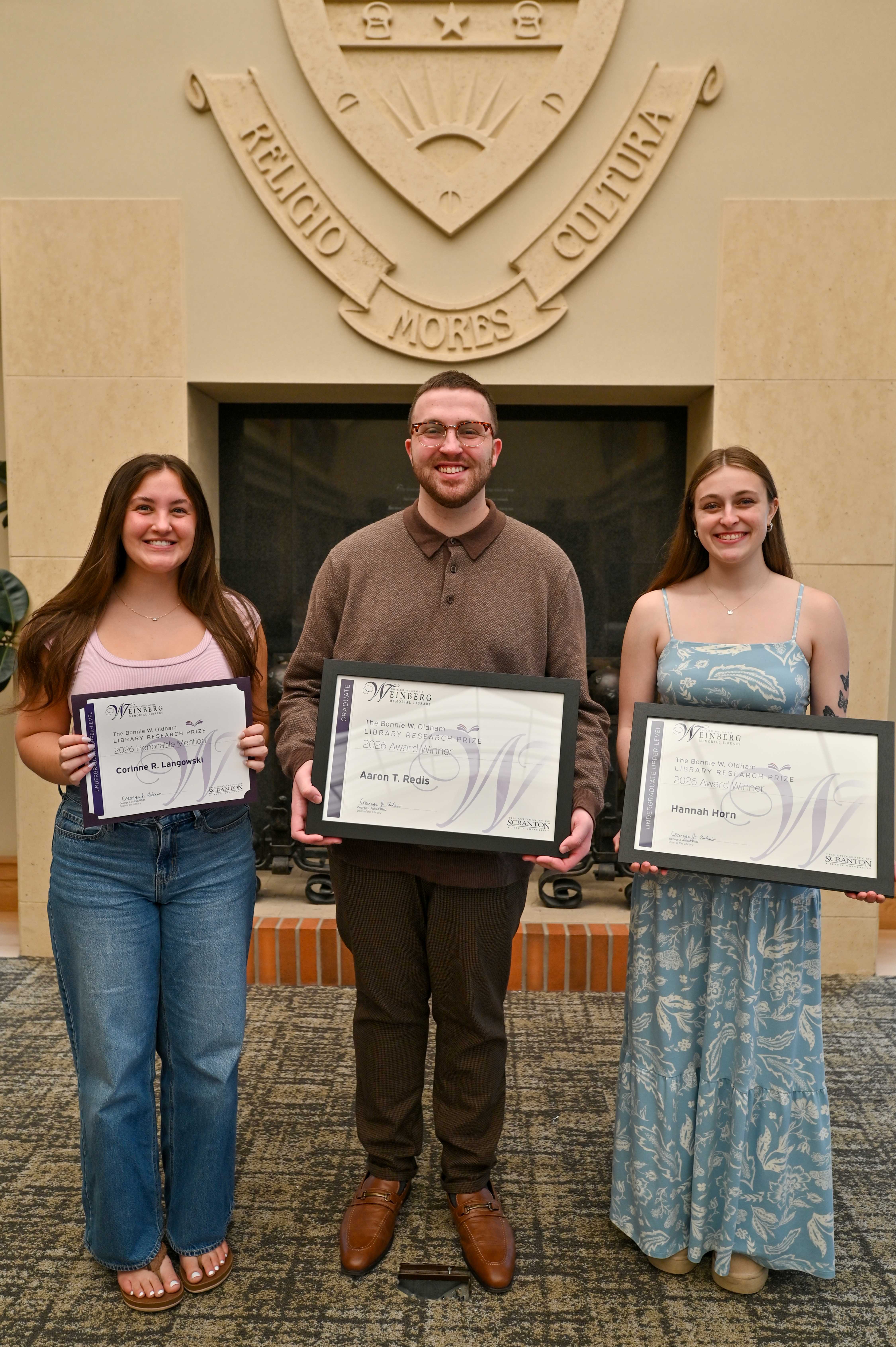
Research Prize honorees holding frames certificates.
2026 Bonnie W. Oldham Library Research Prize Honorees From left to right: Corinne R. Langowski, Aaron T. Redis, and Hannah Horn; Not Pictured: Lucas Camacho, Faith E. Montagnino, Emma McMahon, and Abigail Wall.

Congratulations to all of our honorees!

Special thanks to Kate Cummings, Colleen Farry, and Ian O’Hara for their contributions to this article.

One Week Left! – Application Deadline for Library Research Prize is Monday, May 11, 2026

The Bonnie W. Oldham Library Research Prize

There is one week left to apply for the Bonnie W. Oldham Library Research Prize! The deadline for all projects completed this academic year is Monday, May 11, 2026.

The Bonnie W. Oldham Library Research Prize recognizes excellence in research projects that show evidence of significant knowledge in the methods of research and the information gathering process and use of library resources, tools, and services.

Three prizes of $500.00 each will be awarded to the winning individual student or group in the following categories: Undergraduate Foundational (100-level courses), Undergraduate Upper-level (200- to 400-level courses), and Graduate. If won by a group, the award will be split equally among the group members. All you need to do is write a 500- to 700-word essay describing your research process and how you used the Library in completing the project. Check out our Tips web page for advice on how to craft the best 500- to 700-word essay you can about your research. 

A statement of faculty support from the instructor who assigned the research project is also required for each submission.

For additional information on how to apply, what to include in a completed application, and to access the application, visit the Bonnie W. Oldham Library Research Prize page: www.scranton.edu/libraryresearchprize

Apply Now for the Bonnie W. Oldham Library Research Prize

The Bonnie W. Oldham Library Research Prize

Are you working on a research project in a course this semester? Did you use the Library’s resources, services, collections, or spaces in order to complete your research? Then the Bonnie W. Oldham Library Research Prize is for you!

Update for 2025-2026: Starting this year, there will be one submission deadline for the Bonnie W. Oldham Library Research Prize for all projects completed this academic year. Applications will be accepted on a rolling basis until the deadline has passed.

Monday, May 11, 2026 is the deadline for all projects completed in the Summer 2025, Fall 2025, Intersession 2026, and Spring 2026 academic terms. The application form, found at the contest website, is now open and accepting submissions.

The Bonnie W. Oldham Library Research Prize recognizes excellence in research projects that show evidence of significant knowledge in the methods of research and the information gathering process and use of library resources, tools, and services.

Three prizes of $500.00 each will be awarded to the winning individual student or group in the following categories: Undergraduate Foundational (100-level courses), Undergraduate Upper-level (200- to 400-level courses), and Graduate. If won by a group, the award will be split equally among the group members.

All you need to do is write a 500- to 700-word essay describing the research strategies you used, your use of library tools and resources, your personal learning, and connections you’ve made to the Ignatian characteristics applied to research. Check out the judging rubric and our Tips web page for advice on how to craft the best 500- to 700-word essay you can about your research.

A statement of faculty support from the instructor who assigned the research project, submitted through the faculty support form at the contest website, is also required for each submission.

Winners will be announced in May after the deadline.

For additional information on how to apply, what to include in a completed application, and to access the application, visit the Bonnie W. Oldham Library Research Prize page: www.scranton.edu/libraryresearchprize

Bonnie W. Oldham Library Research Prize Now Accepting Submissions

The Bonnie W. Oldham Library Research Prize

Are you working on a research project in a course this semester? Did you use the Library’s resources, services, collections, or spaces in order to complete your research? Then the Bonnie W. Oldham Library Research Prize is for you!

Update for 2025-2026: Starting this year, there will be one submission deadline for the Bonnie W. Oldham Library Research Prize for all projects completed this academic year. Applications will be accepted on a rolling basis until the deadline has passed.

Monday, May 11, 2026 is the deadline for all projects completed in the Summer 2025, Fall 2025, Intersession 2026, and Spring 2026 academic terms. The application form, found at the contest website, is now open and accepting submissions.

The Bonnie W. Oldham Library Research Prize recognizes excellence in research projects that show evidence of significant knowledge in the methods of research and the information gathering process and use of library resources, tools, and services.

Three prizes of $500.00 each will be awarded to the winning individual student or group in the following categories: Undergraduate Foundational (100-level courses), Undergraduate Upper-level (200- to 400-level courses), and Graduate. If won by a group, the award will be split equally among the group members.

All you need to do is write a 500- to 700-word essay describing the research strategies you used, your use of library tools and resources, your personal learning, and connections you’ve made to the Ignatian characteristics applied to research. Check out the judging rubric and our Tips web page for advice on how to craft the best 500- to 700-word essay you can about your research.

A statement of faculty support from the instructor who assigned the research project, submitted through the faculty support form at the contest website, is also required for each submission.

Winners will be announced in May after the deadline.

For additional information on how to apply, what to include in a completed application, and to access the application, visit the Bonnie W. Oldham Library Research Prize page: www.scranton.edu/libraryresearchprize

Winners of the 2025 Bonnie W. Oldham Library Research Prize Announced

Bonnie W. Oldham Library Research Prize logo

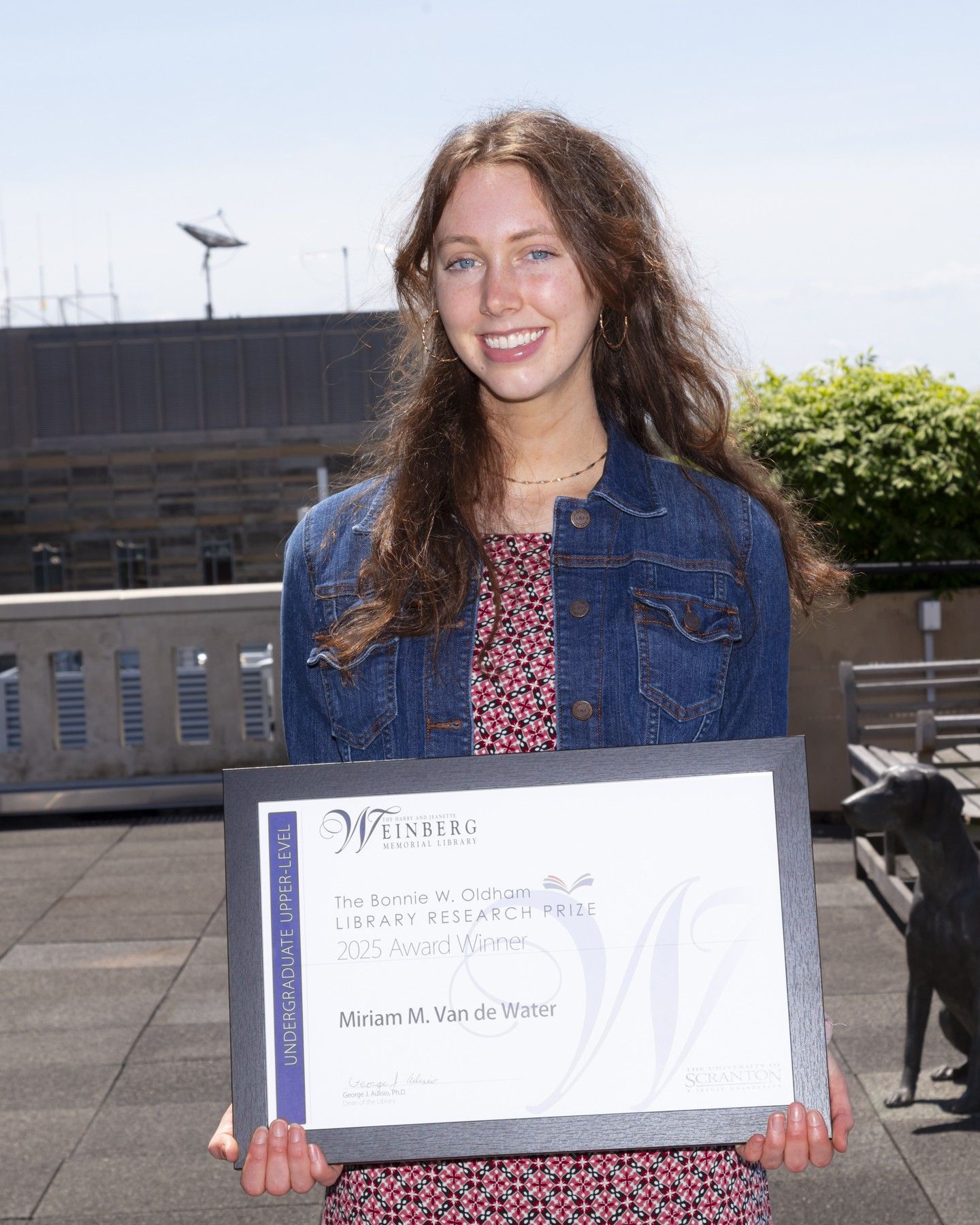
Research Prize Winner Miriam M. Van de Water holding framed certificate.
2025 Bonnie W. Oldham Library Research Prize Undergraduate Upper-level award recipient Miriam M. Van de Water.

Miriam M. Van de Water is the winner of the 2025 Bonnie W. Oldham Library Research Prize in the Undergraduate Upper-level category, which is awarded to the winning project completed in a 200- to 400-level course.

Miriam is a graduating senior Mathematical Sciences and Neuroscience double major with a minor in Philosophy and a concentration in Biology. She submitted to the competition her Honors thesis titled “Examining the Outcomes of Collective Decision Making Over Time,” completed in the course MATH 489H: Honors Project II, advised by Dr. Jason Graham. Miriam explains in her description of research that her Honors research topic, which was “to explore how collective decision-making and sociality influence population fitness,” led her to “discover the importance of breaking large research questions into manageable pieces—whether determining which parameter to test, learning to build simulations, or choosing the best way to visualize complex results.” 

Miriam describes the Library as playing a central role in her research journey. She discusses using the Library’s resources, spaces, and services to structure and support her work; she says, “Being immersed in that space helped structure my thinking and reinforce the seriousness and excitement of the work I was doing.” She describes working on the Library’s second floor while preparing a literature review and using the Library’s computer labs to build simulations and write early drafts of her research paper. She also recounts a research consultation with a faculty librarian that revealed overlooked areas in her honors project, stating: “her input reminded me that research is ultimately about communication, and that excellence isn’t just technical—it’s also about clarity, accessibility, and collaboration.” 

Miriam’s research journey is also characterized by reflection and personal transformation. She discusses living out the Ignatian principle of Contemplation in Action which helped nurture her character and clarify her professional goals. Miriam explains: “My work was rooted in long, quiet hours of focused thought, literature review, and coding—but it was always oriented toward application. I wasn’t just thinking for the sake of thinking; I was using those insights to build something, to contribute to a broader scientific conversation.” 

She concludes her description of research by sharing the following reflection about her work on this project: “This project did more than fulfill a graduation requirement. It taught me how to break down big questions into manageable pieces, how to reach out for help, and how to sit with uncertainty until clarity emerged. It showed me that research is not only about discovery but also about formation—about becoming a person capable of asking better questions, communicating ideas thoughtfully, and navigating complexity with humility and care.” She further reports that her work on this project has helped develop her confidence as a researcher as she prepares to begin her PhD in Biomathematics at North Carolina State University in the Fall.

The Honorable Mention award in the Undergraduate Upper-level category was presented to Faith Montagnino, a third-year English major with Writing and Philosophy minors in the SJLA and University Honors programs, for her project titled “Reading and Writing to Heal: Poetry Therapy as a Tool for Person-Centered Group Therapy,” completed in the course HONR 385H: Poetry as Therapy for Dr. Paul Datti.

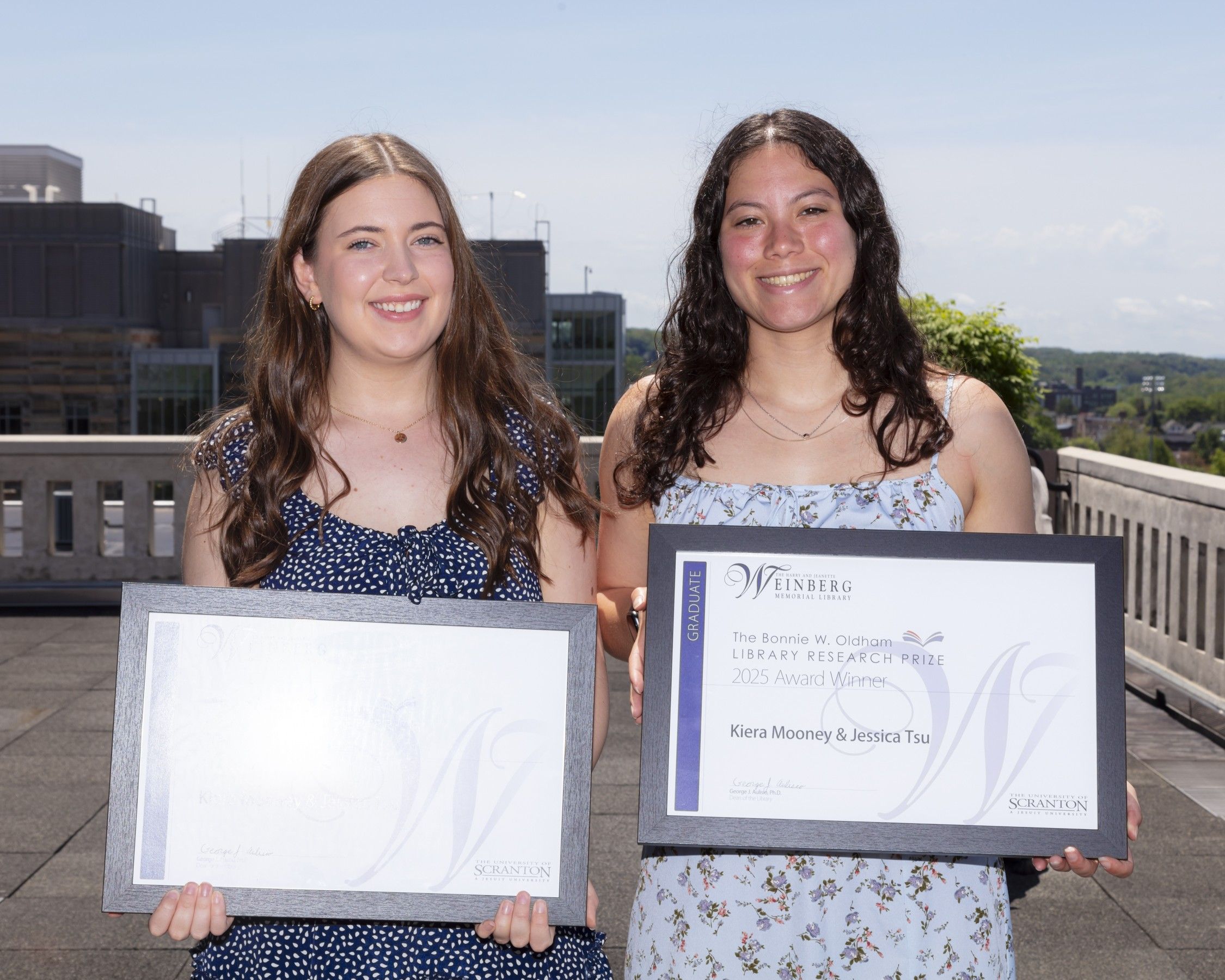
Kiera Mooney and Jessica Tsu are the winners of the 2025 Bonnie W. Oldham Library Research Prize in the Graduate category.

Research Prize Winners Kiera Mooney and Jessica Tsu holding framed certificates.
From left to right: 2025 Bonnie W. Oldham Library Research Prize Graduate award co-recipients Kiera Mooney and Jessica Tsu.

Kiera and Jessica, graduate students in the Master of Science in Occupational Therapy program, submitted to the competition their project titled “The Role of Gender Throughout the History of Occupational Therapy,” completed in the course OT 544: Leadership Principles, Ethics, and Pragmatics, taught by Dr. Marlene Morgan. This historiographical research project explores the role of gender makeup on the occupational therapy workforce over the past century and incorporates evidence from primary sources from the 1910s to present day. 

Kiera and Jessica found this evidence by searching a multitude of Library databases including SAGE Journals, PubMed, MEDLINE, EBSCO, JSTOR, and JAMA Network, as well as the Internet Archive and the Library’s microfilm collection. On the latter, they noted in their description of research, “Looking at the microfilm took an unexpected amount of patience, but it became an immersive experience for us to participate in that further expanded our education.” They also utilized the advanced research technique of citation chasing, which taught them that research “will not always be as simple as typing in one keyword and finding the perfect article.” 

Initially looking for why there were more women than men in the field, the research process evolved for Kiera and Jessica as they found other gender inequities towards women, such as wage gaps, discrimination, and gender stereotypes. They discovered these other dimensions of their topic through the research process, which required that they reassess and change their approach to searching, which “steered [them] in an unexpected direction.” They found this process and discovery enlightening as they confronted the struggles of working women throughout time. 

Kiera and Jessica were pushed by this project to become better researchers and embodied the Jesuit principle of magis, or the “restless desire for excellence.” Realizing they were the first students to choose this topic for their research in this course, they knew they had their work cut out for them. They share, “The hours that we spent scouring databases, citation chasing, using microfilm, and digging through archives exhibit our determination and perseverance in creating a detailed paper that accurately showed the whole story of this topic throughout history.”

The Honorable Mention award in the Graduate category was presented to Doctor of Physical Therapy students Nicolette George, Mary Kallberg, Julia LeMay, and Stephanie Patullo, for the project, “Physical Therapy versus Complementary and Alternative Medicine Effects on Post-Episiotomy Pain: A Systematic Review,” completed in PT 773: Scientific Inquiry III for PT for Dr. Lori Walton.

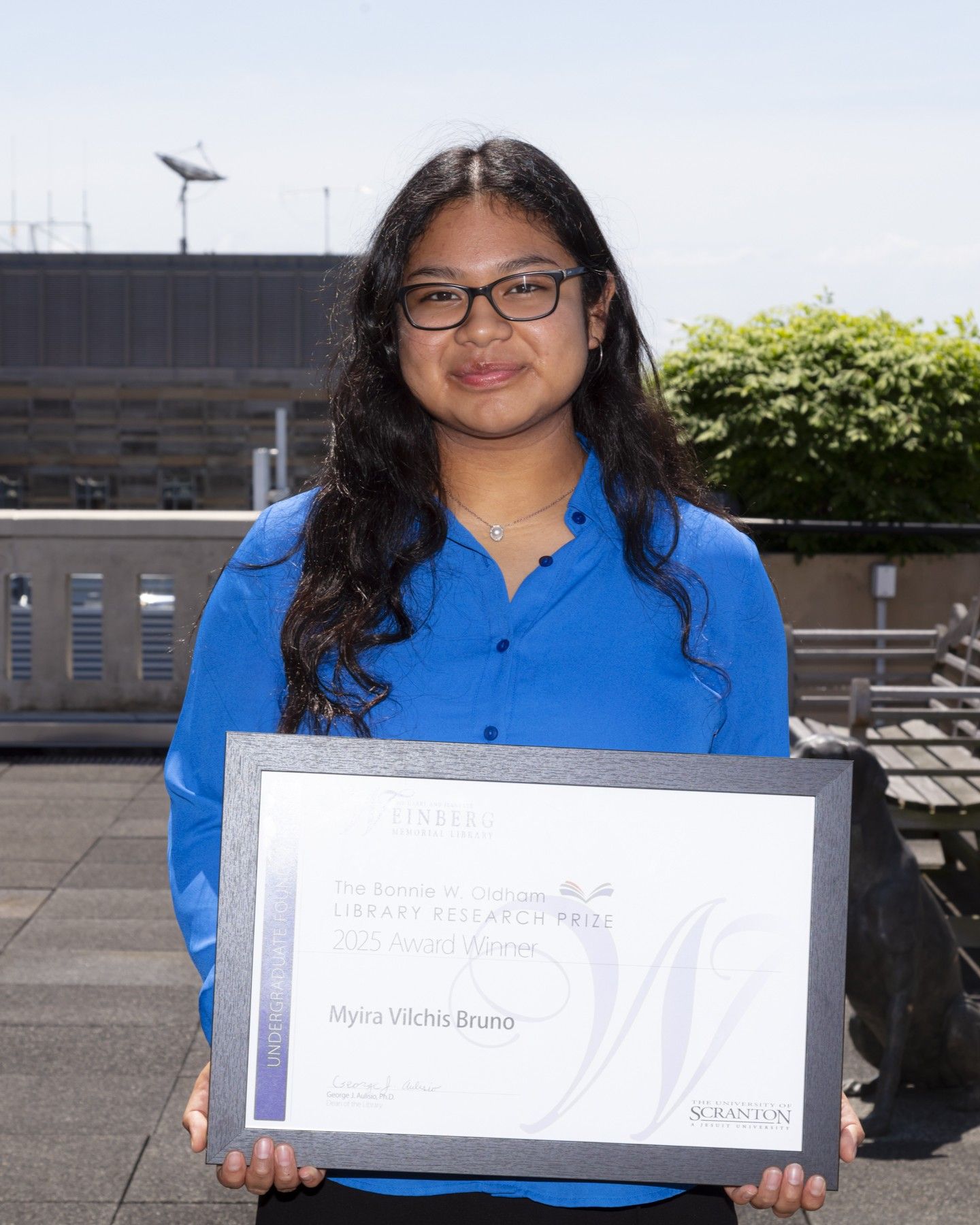
Research Prize Winner Myira Vilchis Bruno holding framed certificate.
2025 Bonnie W. Oldham Library Research Prize Undergraduate Foundational award recipient Myira Vilchis Bruno.

Myira Vilchis Bruno is the winner of the 2025 Bonnie W. Oldham Library Research Prize in the Undergraduate Foundational category, which is awarded to the winning project completed in a 100-level course.

Myira is a first-year Political Science major with a Legal Studies concentration who submitted her paper titled “Directly American,” completed in Prof. Dawn D’Aries Zera’s Writing 107: Composition course. Tasked with researching an argumentative contemporary issue related to her major, Myira chose to research and write on how direct democracies are more beneficial than representative democracies. On her motivation for researching this topic, Myira notes in her description of research, “I am always finding new ways to expand my knowledge of our current democracy and how it alters the law.” 

Myira began her research in an information literacy class taught by a faculty librarian where she learned how to search for materials in a variety of formats that contained evidence she could use to support her argument. In the A-Z list of databases, Myira found the EBSCO database Academic Search Premier, which became one of her most utilized databases for finding useful and relevant sources. She describes using the search filters to narrow her results to peer-reviewed academic journal articles published between 2018 and 2025. Myira also notes the usefulness of the article saving feature in the EBSCO platform, which allowed her to save articles to refer to later while continuing on with her research process. She describes how using different keywords related to her topic enabled her to extend her research beyond analyses of the United States to such countries as Germany, Britain, and Botswana.

Myira also shares that learning about the Library’s Publication Finder tool in her information literacy instruction session prompted her to use it to locate specific journals related to the field of Political Science, such as the Journal of Regional Science and the American Political Science Review, which helped her focus her research more directly on scholarly work related to her essay topic. This tool also enabled her to easily explore streaming media related to her topic that was accessible through the Library, which was a format requirement for one of her sources for this paper.

In reference to her research project, Myira states: “Before sufficiently navigating the library databases, I would spend more time finding sources than writing. This caused me to doubt my writing because I thought it was inaccurate. I grew unmotivated to write, and I no longer enjoyed it like I did before. However, I kept in mind the Ignatian value of Cura Personalis or ‘Care for the Person.’ I was still passionate about making sure I had full support on my side of the argument.” She further notes, “Research on democracies across the globe was a special interest of mine because I hope to practice international law in the future. To advance my future, I had to focus on the present.”

The Honorable Mention award in the Undergraduate Foundational category was presented to first-year Psychology major Erin Augusiewicz, for the project, “Psychedelic Treatment?” completed in WRTG 106: College Writing II for Prof. Dawn D’Aries Zera.

Currently celebrating its 15th year, the Weinberg Memorial Library inaugurated the Library Research Prize in 2011 to recognize excellence in research projects that show evidence of significant knowledge of the methods of research and the information gathering process, and use of library resources, tools, and services. In 2017, the prize was named for Professor Emerita Bonnie W. Oldham, who founded the prize at the University in 2011. The Bonnie W. Oldham Library Research Prize was fully endowed in 2019 and consists of a prize of $500 awarded to winning projects in each of the three categories: Undergraduate Foundational (100-level projects), Undergraduate Upper-level (200- to 400-level projects), and Graduate.

Prize winners were honored at an Awards Ceremony & Reception on Friday, May 16, 2025 in the Charles Kratz Scranton Heritage Room of the Weinberg Memorial Library.

Information about the Bonnie W. Oldham Library Research Prize can be found on the website: http://www.scranton.edu/libraryresearchprize

Congratulations to all of our honorees!

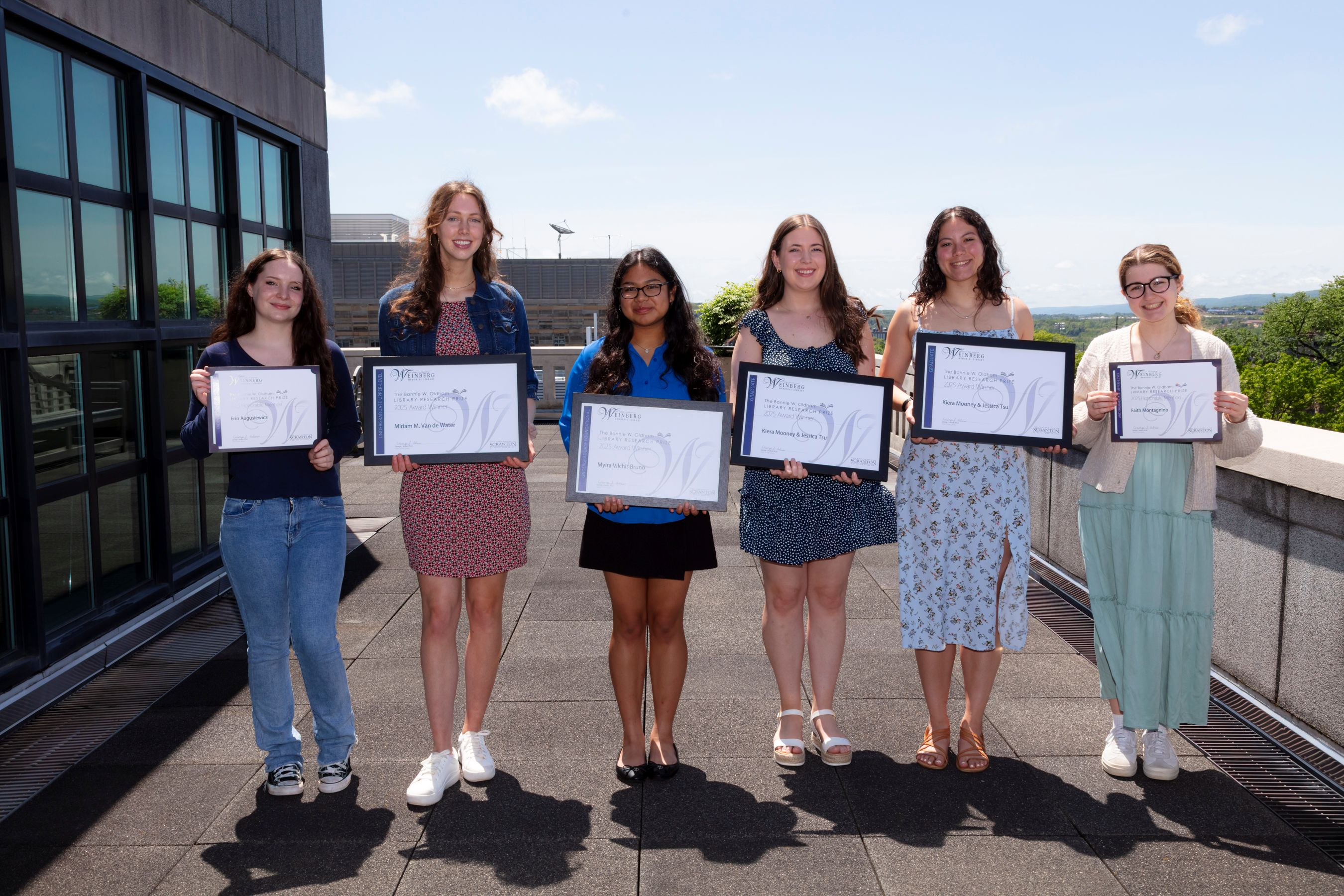
Research Prize honorees holding frames certificates.
2025 Bonnie W. Oldham Library Research Prize Award and Honorable Mention Recipients. From left to right: Erin Augusiewicz, Miriam M. Van De Water, Myira Vilchis Bruno, Kiera Mooney, Jessica Tsu, and Faith Montagnino; Not Pictured: Nicolette George, Mary Kallberg, Julia LeMay, and Stephanie Patullo.

One Week Left! – Application Deadline for Library Research Prize is Monday, May 5, 2025

The Bonnie W. Oldham Library Research Prize

There is one week left to apply for the Bonnie W. Oldham Library Research Prize! Project submissions from Intersession and Spring 2025 courses are due Monday, May 5, 2025 by 4:00 pm.

Are you working on a research project in a course this semester? Did you use the library’s resources, services, collections, or spaces in order to complete your research? Then the Bonnie W. Oldham Library Research Prize is for you!

The Bonnie W. Oldham Library Research Prize recognizes excellence in research projects that show evidence of significant knowledge in the methods of research and the information gathering process and use of library resources, tools, and services.

Three prizes of $500.00 each will be awarded to the winning individual student or group in the following categories: Undergraduate Foundational (100-level courses), Undergraduate Upper-level (200- to 400-level courses), and Graduate. If won by a group, the award will be split equally among the group members. All you need to do is write a 500- to 700-word essay describing your research process and how you used the Library in completing the project. Check out our Tips web page for advice on how to craft the best 500- to 700-word essay you can about your research. 

A statement of faculty support from the instructor who assigned the research project is also required for each submission.

For additional information on how to apply, what to include in a completed application, and to access the application, visit the Bonnie W. Oldham Library Research Prize page: www.scranton.edu/libraryresearchprize

Apply Now for the Bonnie W. Oldham Library Research Prize

The Bonnie W. Oldham Library Research Prize

Are you working on a research project in a course this semester? Did you use the library’s resources, services, collections, or spaces in order to complete your research? Then the Bonnie W. Oldham Library Research Prize is for you!

The Bonnie W. Oldham Library Research Prize recognizes excellence in research projects that show evidence of significant knowledge in the methods of research and the information gathering process and use of library resources, tools, and services.

Three prizes of $500.00 each will be awarded to the winning individual student or group in the following categories: Undergraduate Foundational (100-level courses), Undergraduate Upper-level (200- to 400-level courses), and Graduate. If won by a group, the award will be split equally among the group members. All you need to do is write a 500- to 700-word essay describing your research process and how you used the Library in completing the project. Check out our Tips web page for advice on how to craft the best 500- to 700-word essay you can about your research. 

The application deadline for projects completed in Intersession or Spring 2025 courses is Monday, May 5, 2025 at 4:00 pm.

A statement of faculty support from the instructor who assigned the research project is also required for each submission.

For additional information on how to apply, what to include in a completed application, and to access the application, visit the Bonnie W. Oldham Library Research Prize page: www.scranton.edu/libraryresearchprize

One Week Left! – Application Deadline for Library Research Prize is Monday, December 9, 2024

The Bonnie W. Oldham Library Research Prize

There is one week left to apply for the Bonnie W. Oldham Library Research Prize! Project submissions from Summer and Fall 2024 courses are due Monday, December 9, 2024 by 4:00 pm.

Are you working on a research project in a course this semester? Did you use the library’s resources, services, collections, or spaces in order to complete your research? Then the Bonnie W. Oldham Library Research Prize is for you!

The Bonnie W. Oldham Library Research Prize recognizes excellence in research projects that show evidence of significant knowledge in the methods of research and the information gathering process and use of library resources, tools, and services.

Three prizes of $500.00 each will be awarded to the winning individual student or group in the following categories: Undergraduate Foundational (100-level courses), Undergraduate Upper-level (200- to 400-level courses), and Graduate. If won by a group, the award will be split equally among the group members. All you need to do is write a 500- to 700-word essay describing your research process and how you used the Library in completing the project. Check out our Tips web page for advice on how to craft the best 500- to 700-word essay you can about your research. 

A statement of faculty support from the instructor who assigned the research project is also required for each submission.

Winners will be announced in May after the deadline for Intersession and Spring projects. Although there are two different dates to submit an application, only one judging will take place.

For additional information on how to apply, what to include in a completed application, and to access the application, visit the Bonnie W. Oldham Library Research Prize page: www.scranton.edu/libraryresearchprize

Apply Now for the Bonnie W. Oldham Library Research Prize

The Bonnie W. Oldham Library Research Prize

Are you working on a research project in a course this semester? Did you use the library’s resources, services, collections, or spaces in order to complete your research? Then the Bonnie W. Oldham Library Research Prize is for you!

The Bonnie W. Oldham Library Research Prize recognizes excellence in research projects that show evidence of significant knowledge in the methods of research and the information gathering process and use of library resources, tools, and services.

Three prizes of $500.00 each will be awarded to the winning individual student or group in the following categories: Undergraduate Foundational (100-level courses), Undergraduate Upper-level (200- to 400-level courses), and Graduate. If won by a group, the award will be split equally among the group members. All you need to do is write a 500- to 700-word essay describing your research process and how you used the Library in completing the project. Check out our Tips web page for advice on how to craft the best 500- to 700-word essay you can about your research. 

The application deadline for projects completed in Summer or Fall 2024 courses is Monday, December 9, 2024 at 4:00 pm.

A statement of faculty support from the instructor who assigned the research project is also required for each submission.

Winners will be announced in May after the deadline for Intersession and Spring projects. Although there are two different dates to submit an application, only one judging will take place.

For additional information on how to apply, what to include in a completed application, and to access the application, visit the Bonnie W. Oldham Library Research Prize page: www.scranton.edu/libraryresearchprize

One Week Left! – Application Deadline for Library Research Prize is Tuesday, May 7, 2024

The Bonnie W. Oldham Library Research Prize

There is one week left to apply for the Bonnie W. Oldham Library Research Prize! Project submissions from Intersession and Spring 2024 courses are due Tuesday, May 7, 2024 by 4:00 pm.

Are you working on a research project in a course this semester? Did you use the library’s resources, services, collections, or spaces in order to complete your research? Then the Bonnie W. Oldham Library Research Prize is for you!

The Bonnie W. Oldham Library Research Prize recognizes excellence in research projects that show evidence of significant knowledge in the methods of research and the information gathering process and use of library resources, tools, and services.

Three prizes of $500.00 each will be awarded to the winning individual student or group in the following categories: Undergraduate Foundational (100-level courses), Undergraduate Upper-level (200- to 400-level courses), and Graduate. If won by a group, the award will be split equally among the group members. All you need to do is write a 500- to 700-word essay describing your research process and how you used the Library in completing the project. Check out our Tips web page for updated advice on how to craft the best 500- to 700-word essay you can about your research. 

A statement of faculty support from the instructor who assigned the research project is also required for each submission.

For additional information on how to apply, what to include in a completed application, and to access the application, visit the Bonnie W. Oldham Library Research Prize page: www.scranton.edu/libraryresearchprize