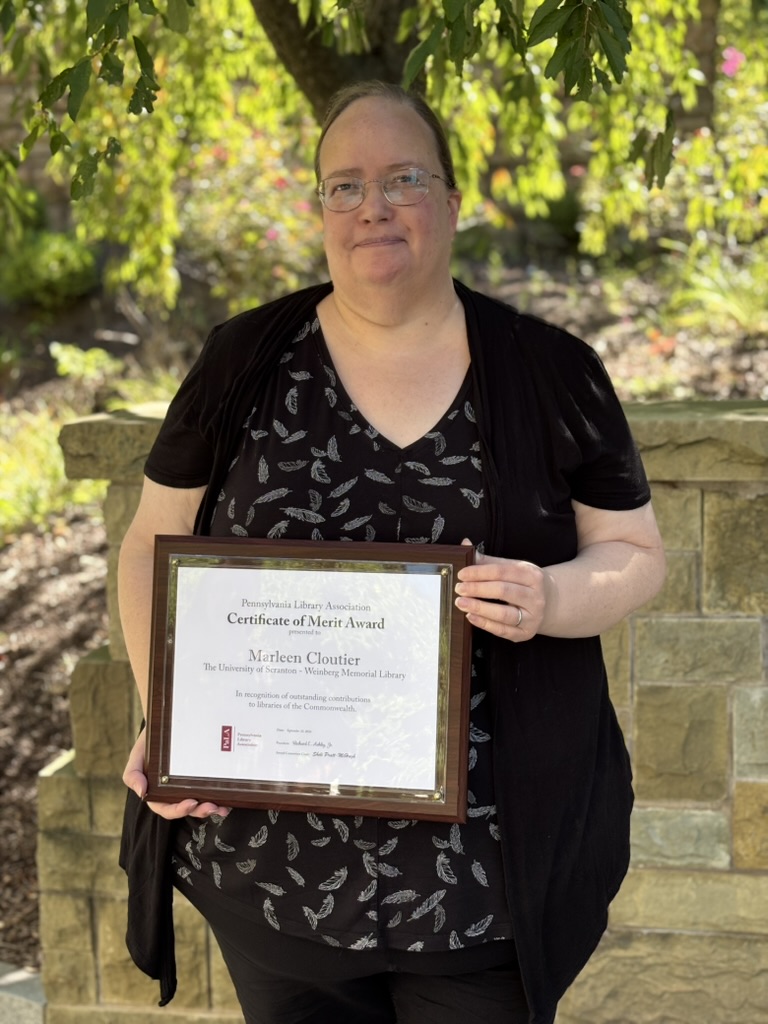
Marleen Cloutier, Associate Professor and Cataloging & Metadata Librarian, was awarded a Certificate of Merit from the Pennsylvania Library Association. Certificates of Merit are presented to individuals making outstanding contributions to libraries and the Pennsylvania Library Association during the past five years.
Prof. Cloutier’s award citation reads: Since 2017, Marleen has demonstrated leadership and problem-solving skills within the Association while serving the Northeast Chapter as Membership Chair, then Nominations and Elections Representative, and later, Chapter Chair. Marleen shared her technical services expertise as a presenter at the Annual Conference and serving in every position within the Technical Services Round Table, including twice as chair. While serving on the 2023 Conference Committee as Chair of the Technical Arrangements Committee, Marleen shared novel strategies for streamlining the conference that continue to be in use. At the University of Scranton, Marleen is co-editor the Weinberg Memorial Library newsletter, chairs an annual environmental art show, and recently revamped the first-year undergraduate student library orientation program.
Marleen has a Master of Science in Library and Information Science with a Concentration in Digital Libraries from Drexel University, and a Master of Science in Human Resources Management from the University of Scranton. She began her career in 2013 as a Library Assistant Intern at Goulston & Storrs Law Library. Later, she was a copy cataloger for Backstage Library Works in 2014-2015. She joined the University of Scranton’s Weinberg Memorial Library in 2016 as a Cataloging Assistant where she is now Associate Professor and Cataloging and Metadata Librarian. Marleen led the University through an intensive investigation into new ILS, recommendation, preparation, and ultimately concluded with a successful migration. She led with calmness, clarity, and organization.
With sincere gratitude for her dedicated professional service to the Association, passion for library technical services, and her enthusiasm for learning and sharing with others, the Pennsylvania Library Association awards a 2026 Certificate of Merit to Marleen Cloutier.
Congratulations, Marleen from everyone at the Weinberg Memorial Library!! Extremely well deserved.
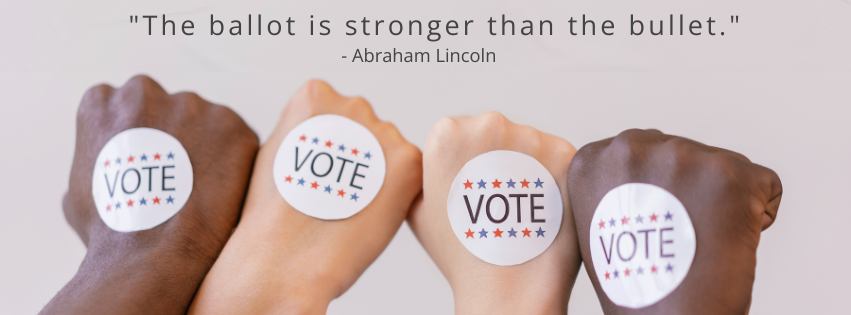
Today is Constitution Day, a day commemorating the signing of the U.S. Constitution on September 17, 1787. One way you can celebrate Constitution Day is to stop by the DeNaples Center Patio between 11 a.m. and 1 p.m. to check out the Voting and Civic Engagement Expo, hosted by the University’s non-partisan Royals Vote initiative. Royals Vote offers a collection of resources, including voter registration forms and information on how to vote.
You might also want to check out some of the Library’s Constitution Day resources:
The United States Constitution established the structure of our federal government, including checks and balances, the division of power between federal and state governments, and limits on governmental power. For a closer look at the original document, you can also explore a scanned version of the Constitution along with America’s other founding documents.
The Weinberg Memorial Library is pleased to welcome the Class of 2030 to The University of Scranton!
First-year students – Sign up for the Heritage Hunt, an interactive introduction to the Library, its services, and resources.
Watch our welcome video to learn more about the Weinberg Memorial Library.
You can consult with a University of Scranton Librarian during our service hours by asking for research assistanceat the first floor Library Services Desk, by calling 570-941-4000, or by using the human-powered Ask a Librarian chat boxes on our website which are available 24/7.
The Library’s Research & Scholarly Servicesdepartment, located on the second floor, can assist you with research, such as finding, evaluating, and citing information. Look for the purple “Research Librarian on call” signs to locate a librarian available for drop-in research assistance. Research consultations can be scheduled by using the Ask a Librarian chat box or by contacting your subject liaison librarian directly by email.
To find resources, such as books, journals, and media, use Royal Search on the Library’s home page. The Library’s large collection of eBooks, electronic journals, and streaming media is available 24/7. To access the Library’s online content, you must first authenticate through my.scranton.edu.
The staff at the Library Services Desk on the first floor can help you borrow and return print materials and laptops. You can also pick up items on reserve, books placed on hold, and interlibrary loan materials. In the lobby area in front of the Library Services Desk you will find New Books recently added to our collection and our Recreational Reading Collection which offers a variety of new and popular fiction and nonfiction.
The Weinberg Memorial Library has five floors and offers a variety of spaces to support your study and research needs including computer workstations, individual study space, group study rooms, quiet study areas, and the Charles Kratz Scranton Heritage Room.
The Library’s Pro Deo Room, Reilly Learning Commons, 2nd floor, and 3rd floor remain accessible to students 24 hours a day when campus is open and include printing stations, quiet study space, group study rooms, and lab computers.
The Reilly Learning Commons (RLC), located on the first floor, is a collaborative space with access to computers, video and audio recording rooms, and reservable group study rooms equipped with whiteboards and monitors.
Our Media and Game Collections are located on the third floor within the Media Lounge. The Media Lounge is an open space with lounge seating for individual study, booths for collaborative learning, and a reservable Media Viewing Room. The EdLab Collection, located within the Media Lounge space, consists of children’s literature, K-12 textbooks, and materials useful for student teaching. Students may borrow Audiobooks, DVDs, Music CDs, Board games, and EdLab Collection materials for five (5) days.
Gale In Context: Opposing Viewpoints is an excellent resource for information on current social issues from topics. This cross-curricular resource supports science, social science, business, and current events. It is an excellent resource for first-year writing students who are working on argumentative or informative papers. The idea of Opposing Viewpoints is to provide informed, differing views which help learners develop critical-thinking skills and draw their own conclusions.
Access Opposing Viewpoints directly through the A-Z database list under Opposing Viewpoints.
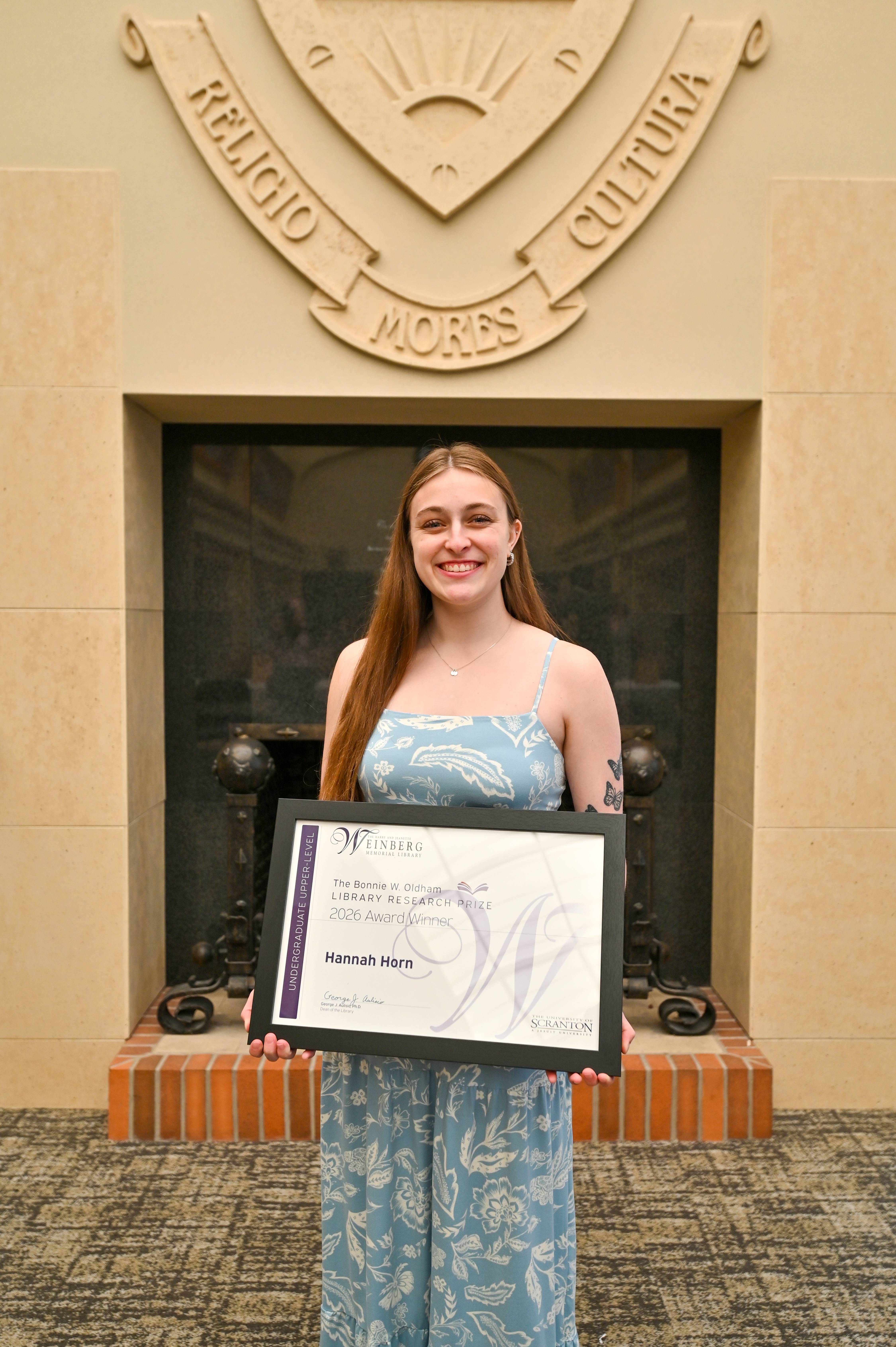
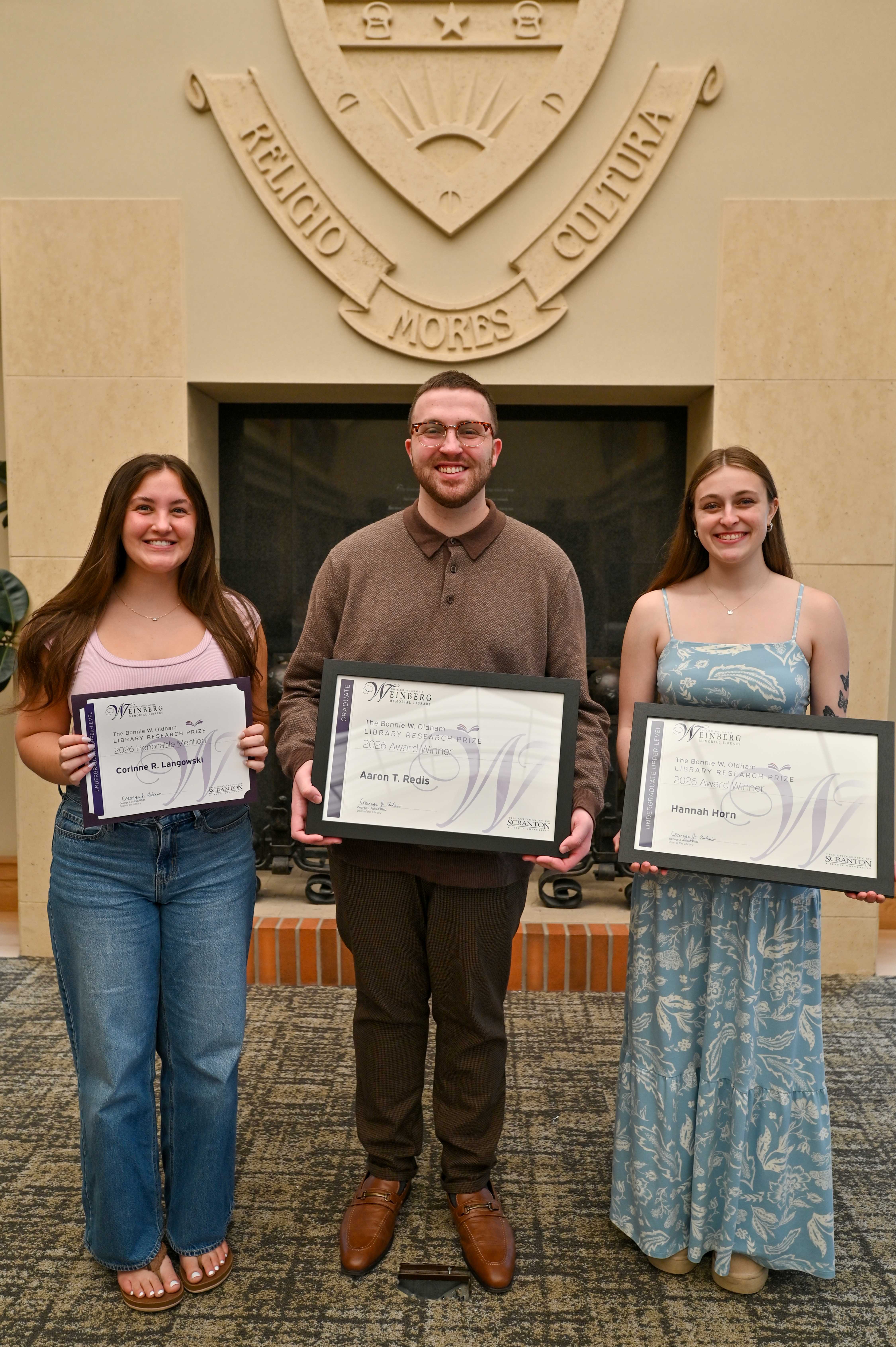
2026 Bonnie W. Oldham Library Research Prize Undergraduate Upper-level award recipient Hannah Horn.
Hannah Horn is the winner of the 2026 Bonnie W. Oldham Library Research Prize in the Undergraduate Upper-level category, awarded to the winning project completed in a 200- to 400-level course.
Hannah is a junior Cybercrime and Homeland Security major with a double minor in Criminal Justice and Criminology. She submitted to the competition her project titled, “Money Laundering through Online Gambling,” completed in the course CJ 231: Environmental Criminology, taught by Dr. Ismail Onat. In choosing a research topic, Hannah explains in her description of research, “My curiosity about money laundering through gambling began from a desire to understand how digital platforms, such as online casinos, introduce new risks to these conventional systems. At the beginning of the project, I recognized that the subject was extensive and impactful but had very little research regarding it.”
For her research, Hannah drew on a range of tools and resources available through the Weinberg Memorial Library, including Royal Search, research guides, and the A-Z Databases list. In her description of the research process, Hannah discusses using the ProQuest Criminal Justice database to locate academic literature on both traditional and emerging money laundering methods, and she supplemented this with JSTOR and EBSCO’s Academic Search Premier to gather literature on regulatory frameworks and organized crime. Because Hannah’s topic sits at the intersection of criminology, cybersecurity, international law, and financial regulation, she describes using the Library’s unified search system to map citations and trace scholarly conversations across disciplines. She also consulted reports from the Financial Action Task Force and the Financial Crimes Enforcement Network (FinCEN), which grounded her research in real-world investigative practice.
Throughout this process, Hannah strengthened her ability to evaluate source quality. She explains, “The library’s resources helped me to distinguish assertions from research grounded in evidence and helped to ensure that all the sources I used were credible and scholarly. I also learned to focus my research on peer-reviewed journals, official documents, and legal examinations, considering the reliability of their publication, research methods, sample size, and the availability of data.” She continues, “These thorough assessments embody the trait of discernment by distinguishing trustworthy information from deceptive or biased origins. This process required patience, contemplation, and a need for open-mindedness when presented with facts and information.”
Exploring this subject led her to consider the social and human dimensions of financial crime. Hannah writes:
Online casino sites […] commonly act as conduits for criminal organizations to exploit vulnerable groups, disrupt economies, and weaken confidence in the financial systems used. Researching this subject prompted me to embrace the concept of cura personalis, meaning acknowledging the human aspect behind what might seem like a purely financial framework. I gained an understanding of how illegal activities impact innocent people and communities, especially in nations with fragile regulatory environments and economies.
Hannah’s paper offers a robust analysis of online casinos as environments that enable money laundering, tracing the legal history of anti-money laundering legislation, applying criminological frameworks, and culminating in an original intervention proposal: an Integrated Account-Centric Anti-Money Laundering System. Her work is both analytically rigorous and practically grounded, demonstrating the kind of critical thinking that defines excellent upper-level research.
The Honorable Mention awards in the Undergraduate Upper-level category were presented to Corinne R. Langowski, a senior Communication Sciences and Disorders major, for her project titled, “Predicting Developmental Outcomes in Toddlers with Early Language Delay Using the Preschool Language Scale – Fifth Edition,” completed in the course CSD 412: Introduction to Research Methods, taught by Dr. Joseph Motzko; and Faith E. Montagnino, a senior English major with Philosophy and Writing minors, for her University Honors project titled, “The Wound as Method: Pain, Language, and Feminist Knowledge in Confessional and Post-Confessional Poetry,” completed in WRTG 489H: Honors Project II, mentored by Dr. Billie Tadros.
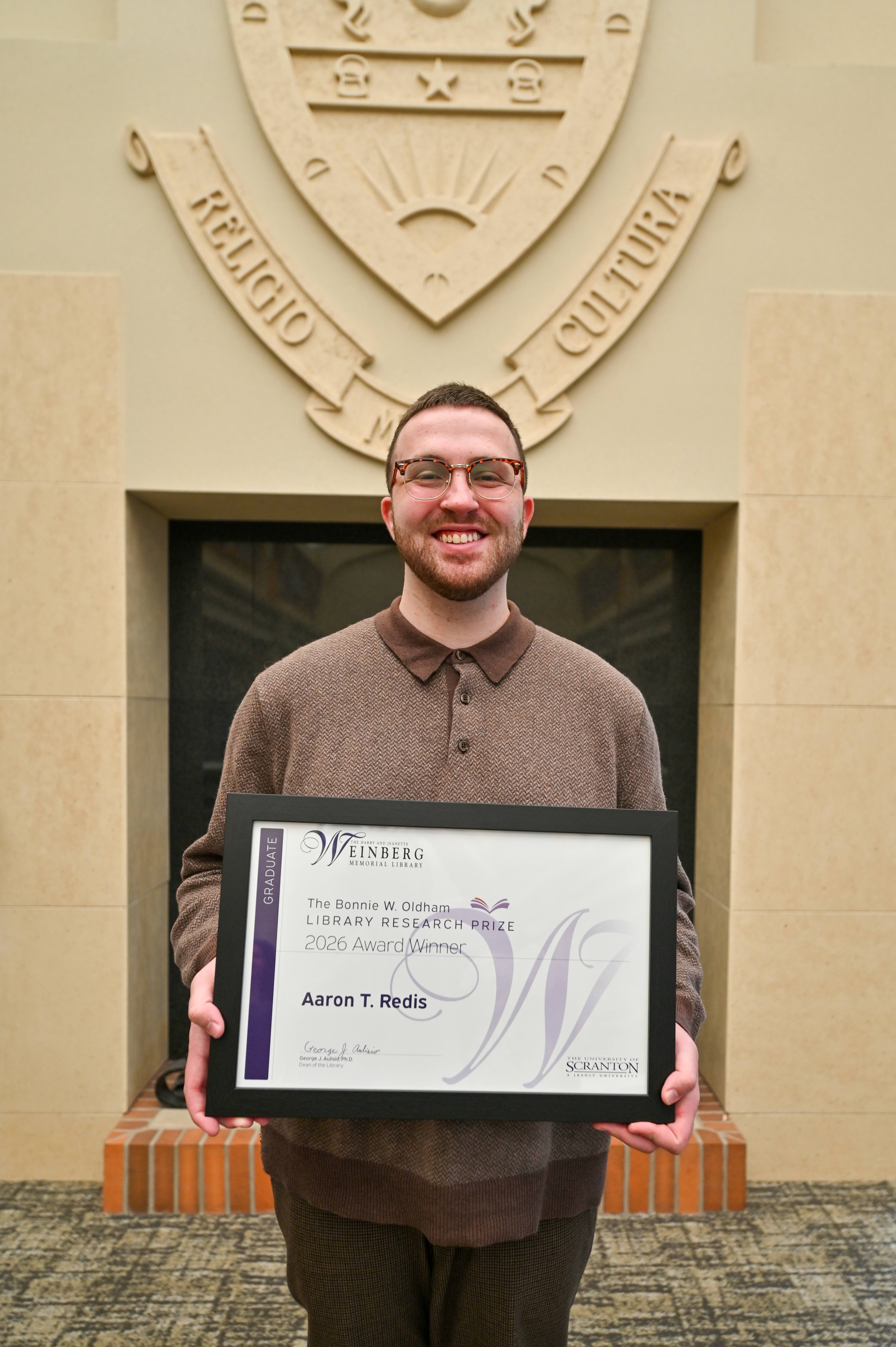
Aaron T. Redis is the winner of the 2026 Bonnie W. Oldham Library Research Prize in the Graduate category.
2026 Bonnie W. Oldham Library Research Prize Graduate award recipient Aaron T. Redis.
Aaron is in the Master of Science in Clinical Rehabilitation Counseling program. He submitted to the competition his project titled, “Seeing Trauma Differently: Evaluating the Efficacy of EMDR Across Varying Abilities and Contexts,” in the course COUN 521: Physical and Psychosocial Aspects of Disability, taught by Dr. Samantha Herrick. Aaron first notes in his description of research that getting started on a research project is often the hardest step. Deciding to research the broader topic of trauma, he utilized the Library’s resources including Publication Finder and Royal Search and came upon Eye Movement Desensitization / Reprocessing (EMDR) Therapy as his research topic for this project. About the scope of his research, Aaron notes, “I initially wanted to center the research on providing this therapeutic modality for individuals with physical disabilities. However, I quickly learned there was a significant gap in the scholarly literature, as I could only locate sources on EMDR for individuals with intellectual disabilities.”
This discovery led Aaron to focus his research on EMDR accessibility overall, relying on key sources to further refine the scope of his project, including in one case a playlist on virtual EMDR which he found through the Library’s search systems and which helped “inform [his] research on adapting EMDR strategies for broader accessibility.” In his description of research, Aaron describes the need to “draw meaningful conclusions” from the information available on a given topic, especially when there may not be direct evidence available on a particular aspect of the topic being researched. This is especially important in evidence-based fields such as clinical counseling practice. His use of a log for his sources, in which he recorded notes on pieces of evidence he found valuable or interesting, was a tool that helped him do this.
Aaron speaks about this process as “research by serendipity,” a phrase he uses in his description of research to describe how the synthesis of existing research may reveal gaps, but one can still build upon those works in a meaningful way to contribute further to the scholarly conversation. He goes on to reflect on his experience in graduate studies of “expecting [a project] to turn out one way, but the further we go along, we see it turn into something better than we may have expected.” He continues, “This taught me the value of being flexible and seeing that sometimes we grow in the process, even if it feels overwhelming or uncertain.”
In his description of research, Aaron reflects on the Jesuit values he identified in his research process for this project. He notes how through the process he learned that “Education is so much more than knowledge” and that “it is also about developing character and leadership,” which is how Aaron put magis into practice in this project. In addition, Aaron’s research discovery that EMDR interventions need to be adapted to individual client needs looks at a person holistically, which is the embodiment of cura personalis. On this, he reflects on what he’s learned about EMDR when he shares, “There is something to be said for a client trusting us with the heaviest parts of their lived experience; we must honor this by encouraging them to care for themselves in and out of the session, and sometimes slowing down or stopping EMDR is the best way to do so.”
Lastly, Aaron speaks about how “deep reflection strongly influenced [his] research process” as he strove for continual improvement in the execution of this research project. He connects this to contemplation in action and notes that “Being able to sift through the research and come back to and draw meaningful conclusions matters a lot and determines how much someone takes away from the process.” Through this, Aaron illustrates how the research process impacts both the researcher and those whom the research will serve.
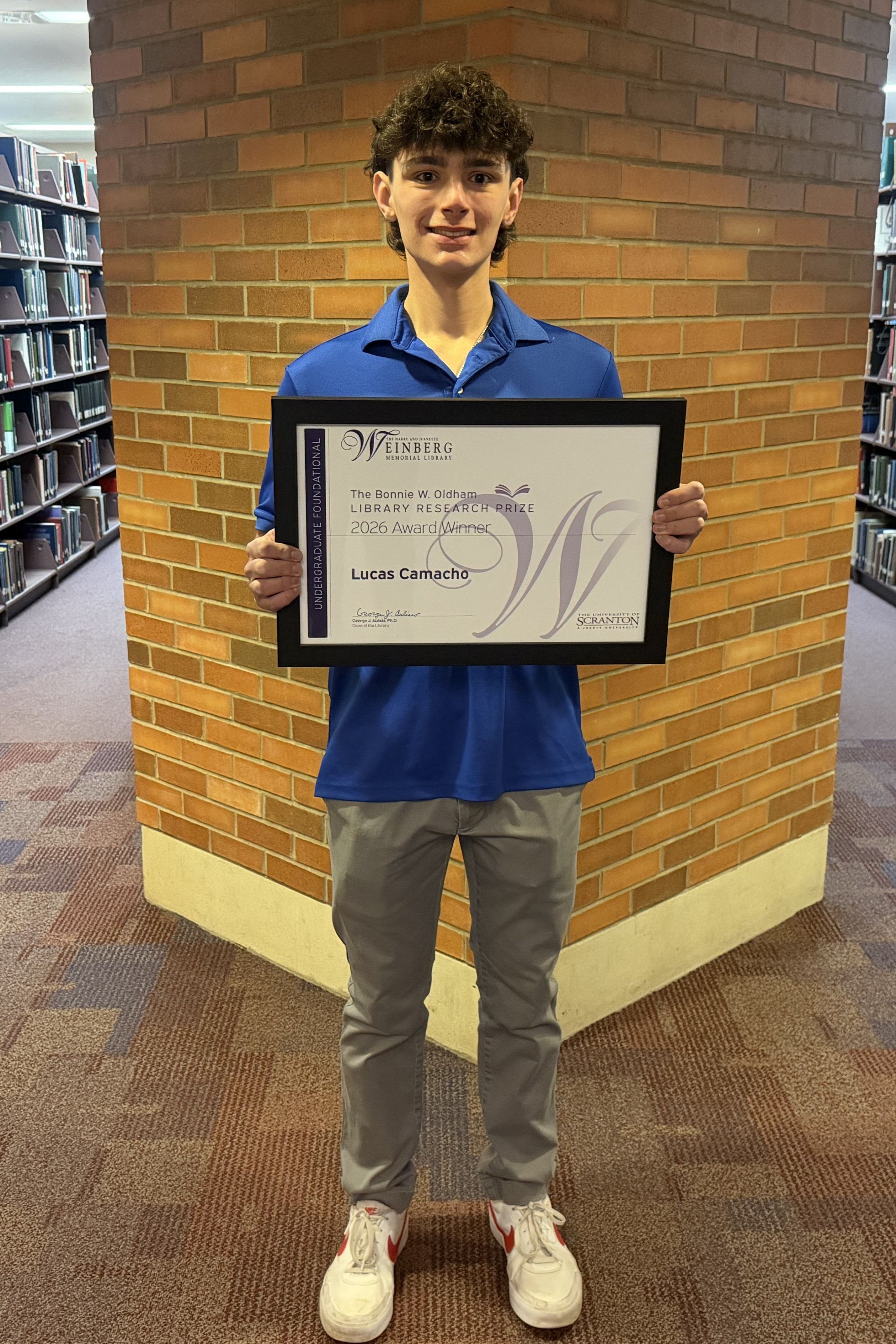
2026 Bonnie W. Oldham Library Research Prize Undergraduate Foundational award recipient Lucas Camacho.
Lucas Camacho is the winner of the 2026 Bonnie W. Oldham Library Research Prize in the Undergraduate Foundational category, awarded to the winning project completed in a 100-level course.
Lucas is a first-year Kinesiology major on a Pre-Med/Pre-PA track who submitted to the competition his paper titled, “Building Habits that Last a Lifetime,” completed in Prof. Dawn D’Aries Zera’s WRTG 107: Composition course. Tasked with researching an argumentative contemporary issue related to his major, Lucas’s goal was to write about wearable fitness trackers. Getting started posed a challenge for Lucas, who shares in his description of research, “I was not sure how to transform that idea into a well-researched and supported argument. I kept telling myself I had to find the ‘perfect’ source to get started. This mindset kept me stuck […] Everything changed when I attended a class session instructed by Donna Witek, Librarian, at the Weinberg Memorial Library. This session gave me the direction needed to put me on the right track for success in this assignment.”
In the information literacy class session, Lucas learned how to effectively use the Library search tools to locate specific materials needed to support his argument. He notes that he had never used many of the tools introduced in this information literacy class, but that the information presented in that class made him “confident about the process and how the information was organized.” Lucas began his research with Royal Search, the Library’s main search tool, which searches all of the Library’s databases, electronic resources, and print and media collections for books, articles, and more. Lucas shares that he immediately started applying the skills he learned in the information literacy class and mentions using features such as the filters provided by the platform to locate scientific, peer-reviewed literature relevant to his research topic, which he accessed through Library-indexed resources including PubMed, JAMA Network Open, The BMJ, Frontiers in Physiology, and The Lancet Digital Health. Lucas experienced success in combining multiple keywords using Boolean operators such as AND and OR to narrow or broaden his searches as needed. He notes, “Gathering evidence started to become a bit easier with each search, and I was able to start building my claim. Seeing the variety of studies that are connected to my topic helped me understand the scope of scholarship involved in academic research.”
Lucas details his use of reading the abstracts of discovered studies to ensure that they would be supportive of the claims he was making in his essay, and that this allowed him to conduct research more efficiently. He goes on to reflect on the research process as a whole saying, “The guidance from Professor Donna Witek helped me grow as a student. I developed a clear understanding of how to do academic research with intention instead of just guessing my way through it. This topic taught me how to find sources, but more importantly, how to think more patiently and critically.” Lucas also described a common challenge when conducting research and the ways he persisted through it using what he learned; he writes: “When I felt like my research process hit a wall, I remembered that Donna told us that research should be treated as a continuous process instead of just a one-time search. Sometimes the search did not bring up high-quality results, and it became frustrating. I was able to stay calm and focused when I remembered this research mindset. This was not just about collecting sources; it was about building the foundation and context of a truly compelling subject for me.”
Lucas further reflected on the role the Ignatian characteristic contemplation in action played in his research when he writes:
Research provided me a chance to reflect on my thinking and fortify my skills, which will serve me further after this assignment. My argument highlighted the importance of building long-term habits. Ironically enough, the research process ended up teaching me the same lesson: progress comes from being consistent in habits. I became more confident in my academic ability based on the skills acquired to search intentionally, evaluate studies, and think critically. The same approach of consistent work, adjustment, and reflection applied to assignments and challenges beyond this one.
The Honorable Mention awards in the Undergraduate Foundational category were presented to Nursing major Emma McMahon, for her project titled, “Prioritizing Cognitive Behavioral Therapy Over Pharmacotherapy,” and to Communication Sciences and Disorders major Abigail Wall, for her project titled, “Does Telehealth Improve Access to Healthcare or Compromise the Quality of it?,” both completed in WRTG 107: Composition for Prof. Dawn D’Aries Zera.
Currently celebrating its 16th year, the Weinberg Memorial Library inaugurated the Library Research Prize in 2011 to recognize excellence in research projects that show evidence of significant knowledge of the methods of research and the information gathering process, and use of library resources, tools, and services. In 2017, the prize was named for Professor Emerita Bonnie W. Oldham, who founded the prize at the University in 2011. The Bonnie W. Oldham Library Research Prize was fully endowed in 2019 and consists of a prize of $500 awarded to winning projects in each of the three categories: Undergraduate Foundational (100-level projects), Undergraduate Upper-level (200- to 400-level projects), and Graduate.
Prize winners were honored at an Awards Ceremony & Reception on Friday, May 22, 2026 in the Charles Kratz Scranton Heritage Room of the Weinberg Memorial Library.
2026 Bonnie W. Oldham Library Research Prize Honorees From left to right: Corinne R. Langowski, Aaron T. Redis, and Hannah Horn; Not Pictured: Lucas Camacho, Faith E. Montagnino, Emma McMahon, and Abigail Wall.
Congratulations to all of our honorees!
Special thanks to Kate Cummings, Colleen Farry, and Ian O’Hara for their contributions to this article.
The Library Services Desk is being remodeled this summer, and will not be accessible. A temporary service point has been set up in the Reilly Learning Commons, and can be accessed through the sliding doors on Galvin Terrace. The book drop will still be accessible in the Monroe Ave. entrance. If entering the library through the Monroe Ave. side, please exit through the opposite doors onto the terrace and then enter the sliding doors to your left to access the Reilly Learning Commons. Thanks!
The Library’s Collaborative Teaching Room (Rm.202) and an additional Group Study Room on the 4th Floor (Rm.419) are now available for student use. Please note the guidelines posted, and good luck preparing for your exams!
There is one week left to apply for the Bonnie W. Oldham Library Research Prize! The deadline for all projects completed this academic year is Monday, May 11, 2026.
The Bonnie W. Oldham Library Research Prize recognizes excellence in research projects that show evidence of significant knowledge in the methods of research and the information gathering process and use of library resources, tools, and services.
Three prizes of $500.00 each will be awarded to the winning individual student or group in the following categories: Undergraduate Foundational (100-level courses), Undergraduate Upper-level (200- to 400-level courses), and Graduate. If won by a group, the award will be split equally among the group members. All you need to do is write a 500- to 700-word essay describing your research process and how you used the Library in completing the project. Check out our Tips web page for advice on how to craft the best 500- to 700-word essay you can about your research.
A statement of faculty support from the instructor who assigned the research project is also required for each submission.
For additional information on how to apply, what to include in a completed application, and to access the application, visit the Bonnie W. Oldham Library Research Prize page: www.scranton.edu/libraryresearchprize
You may know that April is National Poetry Month, but did you know that Thursday April 30 is “Poem in Your Pocket” Day? The Academy of American Poets encourages poetry lovers to celebrate by selecting a poem and sharing it with others throughout the day at schools, bookstores, libraries, parks, workplaces, or on social media using the hashtag #PocketPoem. I like the picture this poem paints, and its sentiments about language.
The Gift by Louise Gluck
Lord, you may not recognize me
speaking for someone else.
I have a son. He is
so little, so ignorant.
He likes to stand
at the screen door, calling
oggie, oggie, entering
language, and sometimes
a dog will stop and come up
the walk, perhaps
accidently. May he believe
this is not an accident?
At the screen
welcoming each beast
in love’s name, Your emissary.
Please consider sharing a poem you love or that inspires you with a friend on April 30, either directly or via social media.
In conjunction with the closing of the Environmental Art Show, please join us for Waymarks Toward Reunion: Making Beauty As a Return to the Earth an Artist Talk with Patrick Beldio, MFA, Ph.D. and Waymarks Fellow Gabriella Palmer, 26′ on April 21 at 5pm in the Charles Kratz Scranton Heritage Room.
What does it mean to return — to the earth, to ourselves, to what is sacred in the ordinary?
This talk brings together a sculptor and a playwright at a shared creative threshold. Patrick Beldio, Artist-in-Residence at the Franciscan Monastery of the Holy Land and Visiting Assistant Professor of Theology and Religious Studies at the University of Scranton, introduces his grant-funded program Waymarks Toward Reunion and reflects on his own creative and spiritual practices, and how these inform and are informed by his scholarship and teaching in the classroom. Gabriella Palmer, Scranton student and Waymarks Fellow, shares her latest original play: a retelling of the Prodigal Son as family drama with magical realism, that also examines the theme of reunion with nature. Beldio and Palmer will discuss what making art asks of both artist and audience, what the word reunion means in a week devoted to the earth, and how they each entered the creative threshold from different doors. The talk concludes with a Q&A.
This event is free and open to the public, light refreshments will be available. This event qualifies as a Life of the Mind Event for First Year Seminar Students. We hope you can join us!
If you have any questions regarding this event please reach out to Marleen Cloutier via email at marleen.cloutier@scranton.edu
 Marleen Cloutier, Associate Professor and Cataloging & Metadata Librarian, was awarded a Certificate of Merit from the Pennsylvania Library Association. Certificates of Merit are presented to individuals making outstanding contributions to libraries and the Pennsylvania Library Association during the past five years.